Swat Board Result 2026: HSSC Part 1 (11th Class) Result Date, Time and How to Check
Here’s the trap that catches students every single year: they believe the first result date they read online. Weeks before any announcement, dozens of pages begin publishing “expected” dates, and many of them never get corrected. Families in Mingora and families in Manchester end up refreshing a website on the wrong day, then wondering whether something went wrong.
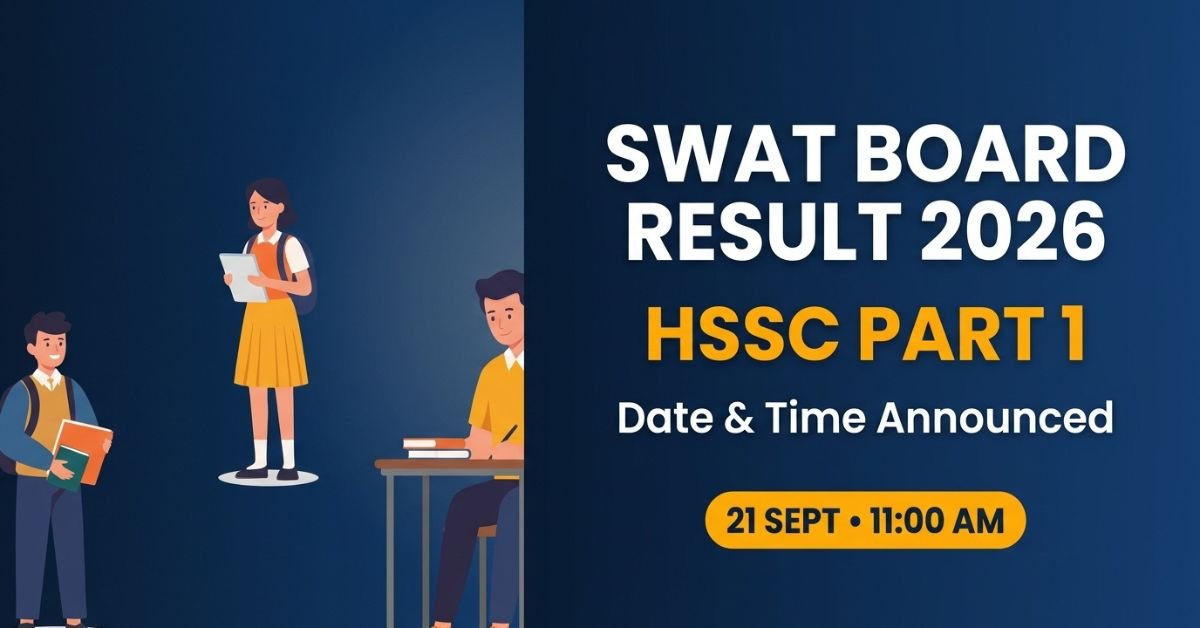
Nothing went wrong. The guesses were simply guesses. The Swat Board Result for the HSSC Annual-I 2026 session now has a fixed date and time: September 21, 2026, at 11:00 AM Pakistan Standard Time. Both first-year and second-year candidates will see their marks online at that hour.
What follows is a practical, ten-point guide for Class 11 students of Swat, Buner and Shangla — and for the parents, siblings and relatives following along from other countries.
The Result Date Is Monday, September 21, At 11:00 AM
A confirmed hour takes a lot of stress out of result day. There’s no reason to stay awake past midnight or to check the website at dawn. The marks go live at eleven in the morning, Pakistan time, and that’s when colleges will also start receiving the full list.
For readers outside Pakistan, the same moment looks like this on September 21:
- UAE and Oman: 10:00 AM
- Saudi Arabia, Qatar, Kuwait, Bahrain: 9:00 AM
- Central Europe (Italy, Germany, France): 8:00 AM
- United Kingdom: 7:00 AM
- US East Coast: 2:00 AM
- US West Coast: 11:00 PM on Sunday, September 20
A word of patience, too. Education board websites almost always slow down in the first hour of a big release. If the page won’t load at eleven sharp, give it a quarter of an hour before trying again.
Class 11 And Class 12 Arrive On The Same Day
In some parts of Pakistan, the second-year result is released first and the first-year result weeks later, because final-year marks drive university admissions. Swat Board is releasing both classes in a single announcement for this session.
That’s good news for Part 1 candidates, who get clarity sooner and can plan their second year with real numbers in hand. The catch is traffic. Two full classes checking results in the same hour means the website will be busier than usual, so a little patience goes a long way.
How To Check Your Swat Board Result By Roll Number
Step 1: Keep The Roll Number Handy
It’s printed on the admit card issued before the exams. If a parent abroad is checking on a student’s behalf, send them the number in advance so nobody is hunting for a slip at the last minute.
Step 2: Go To The Official Board Website
Use only the official BISE Swat website. Copycat result portals sometimes show outdated or incomplete data, and some are loaded with intrusive ads.
Step 3: Pick The Right Exam And Session
Choose HSSC and the Annual-I 2026 session. Picking the wrong year or the supplementary session is the most common reason students see a “record not found” message.
Step 4: Enter The Roll Number Carefully
One wrong digit can bring up nothing at all — or someone else’s marks. Type it slowly and check it before pressing search.
Step 5: Save And Share A Copy
Take a screenshot and, if possible, a PDF or printout. Families spread across countries often share the result on messaging apps; a clear screenshot saves repeated questions and keeps a record for admission forms.
Regular students can also confirm their marks through their college, which receives the complete gazette from the board.
Don’t Trust An SMS Code Until The Board Confirms It
Text-message results are popular in areas with weak internet, and they spare you the website rush. The problem is that unofficial pages circulate different codes, each labelled as the right one. Sending your roll number to the wrong number wastes money and returns nothing.
A sensible approach:
- Wait for the board’s own notice on result day before using any SMS service.
- Ask your college office, which gets official circulars directly.
- If you’re overseas, remember that short codes generally work only on Pakistani mobile networks. Use the website instead.
Even when SMS works, it usually shows only total marks and status. For subject-by-subject detail, you’ll need the website or your college.
Position Holders Are Recognised At A Ceremony
Like most boards in Pakistan, BISE Swat marks its results with a ceremony for the students who secure top positions. These announcements tend to travel fast on social media, and overseas communities from the region often celebrate them as if they were family news.
For most students, though, the position list is interesting rather than important. What matters is your own score and what it lets you do next. If you’re expecting an outstanding result, your institution will usually be informed before the public list circulates.
Your DMC Will Not Be Ready On Result Day
It’s easy to assume the screen you see on result morning is your final document. It isn’t. The DMC is the official record, and distribution begins on September 25, 2026. Regular students typically receive it through their colleges, while private candidates follow the board’s own collection instructions.
A few practical notes:
- Regular students: Wait for your college rather than travelling to the board office.
- Private candidates: Keep your roll number slip and identity document (B-Form or CNIC) ready for collection.
- Students or families abroad: If a trusted relative will collect the DMC, check in advance whether the board requires an authority letter or copies of identity documents.
- Early deadlines: If any form wants a DMC before it’s issued, attach the online printout and mention the certificate is awaited.
Part 1 Marks Count Toward Your Final Intermediate Total
In Khyber Pakhtunkhwa, the intermediate certificate combines Part 1 and Part 2 into a single total, generally out of 1,100. A shaky first year pulls the final percentage down, however strong the second year turns out to be.
That final percentage travels further than many students realise:
- Local universities use it heavily in merit calculations for medicine, engineering and other competitive programmes.
- Universities abroad — in the UK, Europe, the Gulf, Turkey, China, Malaysia and beyond — look at intermediate grades when assessing Pakistani applicants, often alongside English-language test scores.
- Scholarships, both domestic and international, frequently set minimum percentage thresholds.
If Part 1 didn’t go as planned, don’t panic. A full year of Part 2 remains, and improvement options may be available under board rules.
Rechecking Has A Short Window
Boards usually open a limited window after results for rechecking applications. The deadline and fee are set in the board’s post-result notice for each session, so rely on that notice rather than old figures floating around online.
Know what you’re asking for. Rechecking normally confirms that every answer was marked, that totals were added correctly and that marks were entered accurately. It isn’t usually a complete re-marking of your paper’s quality. Scores change only when a real mistake is found.
For students abroad, check whether the application can be submitted online or needs someone in Pakistan to handle it in person — and allow time for that.
Failed A Paper? There Is A Second Chance
KP boards hold a second examination session, commonly called Annual-II or the supplementary exam, for students who didn’t pass a subject or want to raise their marks. The board announces its admission dates and fees separately after the main result.
If your card shows a failed paper:
- Note the subject and your marks — you need at least 33% in each subject to pass.
- Decide early between rechecking (if you suspect a marking error) and preparing for the next session.
- Register before the normal deadline, since late fees usually rise in stages.
For Part 1 students, clearing a failed subject promptly protects the final certificate — which foreign universities and employers will want to see clean and complete.
Check Every Line Before You Celebrate
A misspelt name might seem trivial on a local result card. It stops being trivial when a visa officer, an overseas admissions office or an attestation desk compares it with your passport. Take two minutes now:
- Name and father’s name — must match your B-Form, CNIC or passport exactly.
- Roll and registration numbers — both carry into Part 2.
- Group and subjects — pre-medical, pre-engineering, computer science, humanities or general science.
- Subject marks — theory and practical entered correctly.
- Result status — pass, fail or any unfamiliar code.
If you plan to study abroad eventually, keep in mind that intermediate certificates used outside Pakistan normally need official attestation. Clean, correct documents make that process far smoother.
Quick Dates At A Glance
| Event | Date |
|---|---|
| HSSC Annual-I result (Class 11 and 12) | September 21, 2026, 11:00 AM Pakistan time |
| DMC distribution begins | September 25, 2026 |
| Rechecking window | As per the board’s post-result notice |
| Annual-II (supplementary) admissions | As per the board’s separate notice |
Your Next Steps After September 21
- Check the result at 11:00 AM Pakistan time, converting to your local time if you’re abroad.
- Save a screenshot and printout, and share one clear copy with family.
- Verify every detail against your identity documents.
- Apply for rechecking quickly if a subject score looks wrong.
- Collect your DMC from September 25, arranging an authorised relative if you’re away.
- Register for Annual-II on time if a subject needs clearing or improving.
- Build your Part 2 plan around your weakest Part 1 subjects — and, if studying abroad is the goal, start researching entry requirements now.
FAQ
Which districts come under the Swat Board?
BISE Swat serves students from Swat, Buner and Shangla. Candidates registered with this board check their marks on its official website.
What are the passing marks for HSSC Part 1 in Swat Board?
A student needs at least 33% in every subject. A failed subject can be attempted again in the next examination session.
Can I check the result from outside Pakistan?
Yes. The online result works from any country with an internet connection. SMS short codes, however, generally work only on Pakistani mobile networks.
Can private candidates see their result online?
Yes. Private candidates use the same roll number search as regular students. Only the DMC collection process is different.