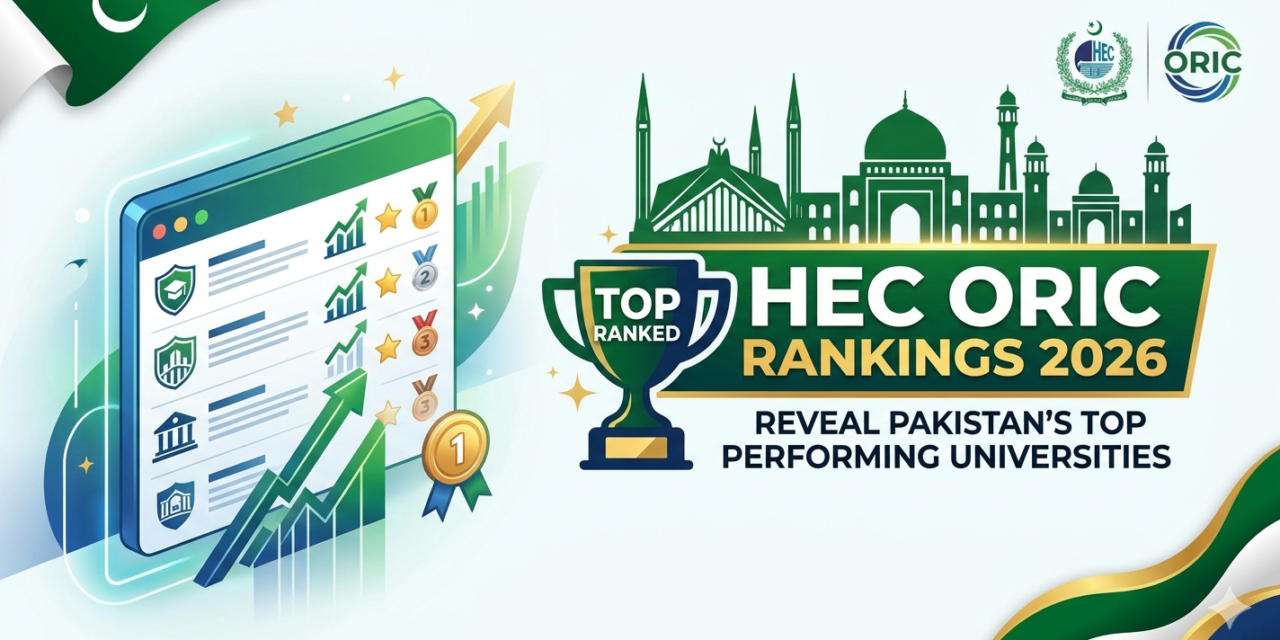
HEC ORIC Rankings 2026
The Higher Education Commission’s latest Annual ORIC Self-Assessment Evaluation Report for FY2024-25 has once again put the spotlight on a performance of research, capacity of innovation, and progress of a commercialization in across the university sector of Pakistan. The report have reviewed a 95 universities and divided them into a four categories of performance: W, X, Y, and underperforming. What have makes this assessment as especially important is that it does not only measure an academic reputation in the traditional sense. Instead, it have focuses on how actively the universities are building an ecosystems of research, supporting the innovation, encouraging an applied knowledge, and creating a stronger links in between an academia and industry. In a landscape of higher education where a productivity of research and commercialization are becoming as increasingly important, the rankings of ORIC have offer a meaningful picture of which the institutions are moving as forward and which ones still need a serious improvement.
According to the report, only a seven universities have secured the highest “W” category, with showing that the very top tier of a research and performance of innovation have remains as highly competitive. At the same time, 38 universities were placed in the “X” category, 43 in the “Y” category, and seven were declared as underperforming. These numbers have reflect a mixed picture: while a several institutions have clearly strengthened their structures of research, a large number of the universities are still struggling to build a consistent momentum. The report have also reveals a rising activity of research, as universities submitted a 9,987 proposals of research in during the FY2024-25 as compared with just a 2,237 in the previous fiscal year. That increase signals growing interest in research, but the approval rate dropped to around 12.5 percent, showing that competition for a funding has become as tougher. Together, these findings have make the HEC rankings of ORIC an important indicator of the direction in which the higher education system of Pakistan is heading.
HEC Releases Annual ORIC Evaluation Report for FY2024-25
The Annual ORIC Self-Assessment Evaluation Report is one of the most useful tools for understanding that how universities are performing in a research, innovation, and commercialization. ORICs, or Offices of Research, Innovation and Commercialization, are designed to help the universities move as beyond a teaching in classroom and develop a stronger culture of research that can contribute to a national growth. They support a faculty and students in the proposal writing, funding applications, industry partnerships, development of patent, and commercialization of an ideas. In this way, ORICs have play a central role in turning the universities into an active contributors to the economy rather than the institutions that only deliver a degrees. The latest evaluation report of HEC have shows that the role of an ORICs is becoming as more visible in across the Pakistan, but it also shows that how uneven the progress still is from one university to an another.
The report have assessed universities on an indicators of performance that are linked to a leadership, staffing, development of proposal, and systems of a research support. It have categorised the institutions into an W, X, Y, and underperforming tiers, with allowing the stakeholders to identify both a top performers and those needing urgent attention. This type of a ranking have matters because it have creates an accountability. Universities are encouraged to improve an internal structures, appoint a qualified managers of research, and ensure that the activities of ORIC are not treated as a formality. The report have also highlights a major national trend: universities are submitting a far more proposals of research than before, which have suggests that interest in the research is growing. However, the falling rate of approval have shows that funding is limited and expectations of quality are rising. As a result, institutions must not only increase the number of a proposals but also improve their quality, relevance, and alignment with a national priorities.
Only Seven Universities Achieve the Top “W” Category
The biggest headline from the report is that only a seven universities that have managed to enter the top “W” category, the highest tier in the HEC ORIC rankings. These universities are Air University, the National University of Sciences and Technology (NUST), NED University of Engineering and Technology, Sukkur Institute of Business Administration, The University of a Lahore, the University of Agriculture Faisalabad, and Ziauddin University. Their placement at the top have indicates that they have not only established a functional systems of ORIC but have also been able to create a strong culture of research which is supported by a capable leadership, efficient staffing, and pathways of an active innovation. For other institutions in across the country, these universities have provide a useful model of what an environment of a strong research can look like in a practice.
Being placed in the W category is not just a matter of the prestige. It have usually reflects an ability of institution to manage the proposals of research as efficiently, support a development of faculty, encourage the commercialization, and build a strategies on long-term for an innovation. It have also suggests that these universities have invested in maintaining a full-time leadership of ORIC and have aligned with a priorities of research with a broader academic goals. In a highly competitive environment of higher education, this level of a performance can improve an institutional reputation, attract the better faculty, and strengthen a confidence of student. It may also increase the chances of a partnerships with the industry and bodies of funding. For a universities that are seeking to improve their own rankings, the top category have shows that a sustained focus on the systems, governance, and quality of research can produce a measurable results over the time.
Universities in the X Category Show Strong but Uneven Progress
A total of 38 universities were placed in the “X” category, which have shows a solid performance but also indicates a room for the improvement. This group have includes a well-known institutions such as the Aga Khan University, Dow University of Health Sciences, Iqra University, Quaid-i-Azam University, Lahore University of Management Sciences, Mehran University of Engineering and Technology, Bahria University, COMSATS University Islamabad, the Institute of Business Management, and Shaheed Zulfikar Ali Bhutto Institute of Science and Technology. These are significant names in the academic landscape of Pakistan, and their presence in the X category have confirms that they have maintained an active functions of ORIC and a reasonably strong profile of research. However, being as below the top tier have also suggests that a consistency, leadership, or outcomes of commercialization may still need as strengthening.
The X category is important because it have includes universities with a potential of serious research. Many of these institutions already have a strong recognition of brand, diverse academic programs, and active communities of a faculty. The challenge is turning that potential into a more structured and measurable output of research. In many cases, universities may have active researchers but limited commercialization pathways, or they may produce proposals without converting them into approved projects at a high rate. Others may have a good academic reputations but weaker structures of an ORIC leadership. The report, therefore, should not be seen as a criticism alone; it is also a roadmap. Universities in the X group are close to the highest bracket of performance and can move as upward if they strengthen an internal planning, appoint the full-time heads of ORIC, improve a quality of proposal, and create a stronger connections in between the research and real-world impact.
The Y Category Reflects the Need for Greater Institutional Strength
The largest group in the report consists of 43 universities placed in the “Y” category. This have includes the University of Karachi, the University of the Punjab, Sindh Madressatul Islam University, Jinnah University for the Women, Lahore College for Women University, Islamia College University, Abdul Wali Khan University, and the University of Peshawar. These are important institutions with a long academic histories and large bases of student, yet their placement in the Y category have shows that a governance of research and support of commercialization are still not at the level which is required for a stronger performance. In many cases, these universities may have an active programs of teaching and respectable academic reputations, but their ORIC systems may not be functioning with the same efficiency as those found in a higher-ranked institutions.
This category is especially significant because it have includes many universities that could potentially improve as quickly if a structural issues are addressed. The report have suggests that the presence of an ORIC alone is not enough; what have matters is whether it is fully staffed, properly led, and capable of driving an activity of strategic research. Universities in the Y category may need a better training for the teams of research, stronger support of proposal development, and more consistent administrative coordination. They may also need to improve their ability to connect with an industries, donors, and bodies of funding. Since the majority of universities fall within this category, the findings show that Pakistan’s higher education sector still has substantial a room to grow. A university in the Y category is not necessarily weak in all the respects, but it is not yet making full use of its research and potential of innovation as either.
Seven Universities Were Declared Underperforming
The report have also identified seven universities as underperforming, that are including the Bacha Khan University, Greenwich University, Karakoram International University, Shah Abdul Latif University, Shaheed Benazir Bhutto Women University, Shaheed Zulfikar Ali Bhutto Medical University, and the University of Swat. Their placement in the lowest tier is a reminder that some universities are still facing a serious challenges in building an effective systems of research. Underperformance in a rankings of ORIC can be linked to many factors, with including a weak leadership, lack of the full-time research managers, insufficient proposal development support, poor coordination, and limited institutional focus on an innovation. In some cases, universities may also struggle with a constraints of resource or administrative instability that have affects a planning on long-term.
Being placed in the underperforming category should not be seen only as a negative label. Instead, it should be treated as a warning sign and an opportunity for the urgent reform. If a university is repeatedly struggling in a research and commercialization, it may need to review its structure of ORIC, hire a stronger leadership, and invest in the staff training. It may also need to create a clearer strategy of research that have aligns with a local and national needs. The report’s value have lies in making these weaknesses as visible so that universities can respond with a targeted action. For a students, members of faculty, and policymakers, the underperforming category have highlights the uneven distribution of a research capacity in across Pakistan. Improving these universities will require a time, support, and accountability, but the rankings at least provide a clear point of starting for reform.
Research Activity Is Rising, but Funding Competition Is Getting Tougher
One of the most striking findings in the report of HEC is the sharp increase in a proposals of research which is submitted in during a FY2024-25. Universities in across the Pakistan have submitted a 9,987 proposals of research, a dramatic rise from the 2,237 proposals in the previous fiscal year. This jump have shows that a culture of research is gaining to strength and that more members of faculty and institutions are engaging with the process of a development of proposal. On the surface, this is a positive sign for the higher education sector of country because it have suggests that universities are becoming as more ambitious and more willing to compete for an opportunities of research. It also means that the ORICs are likely becoming as more active in an encouraging submissions of project and supporting researchers through the process of application.
At the same time, the report have notes that the approval rate have fell to around a 12.5 percent. That figure have tells an important story: while more proposals are being submitted, the competition has become as much tougher, and available funding have remains as limited. The lower rate of approval may also indicate that a quality of proposal is not improving at the same pace as a submission volume. Universities therefore need to focus not only on a quantity but also on the quality, relevance, feasibility, and impact. A successful proposal today must be clearly aligned with a priorities of research, well structured, and capable of producing a meaningful outcomes. The increase in a submissions of proposal is encouraging, but unless a universities have strengthen their research support systems and train a faculty as more effectively, many of those proposals may continue to fail in the stage of approval.
Also Read: Punjab Private Schools Sealed for Violating Summer Vacation Orders
Leadership Gaps Remain a Major Challenge for ORIC Performance
Another critical finding in the report of HEC is that only a 68.42 percent of universities currently have a full-time ORIC heads. Although more than 85 percent of the institutions have a full-time managers of research and innovation and managers of commercialization, the absence of a permanent ORIC leadership is still affecting the planning of research and an institutional performance. A strong ORIC have needs more than just a presence of staff; as it have requires a stable leadership that can guide the strategy, coordinate a departments, follow up on the proposals, and maintain a consistent institutional priorities. Without a full-time leadership, functions of ORIC may become as fragmented, slow, or overly dependent on a temporary arrangements.
This gap of a leadership have matters because universities with a clear accountability and dedicated research management are more likely to improve over the time. A full-time ORIC head can build the momentum, strengthen an engagement of faculty, and help to convert the ideas into a funded projects and commercial opportunities. In a contrast, universities with a weak leadership may struggle to maintain a continuity, which can lower their ranking and reduce a productivity of research. The report of HEC is therefore also a reminder that governance have matters just as much as ambition. If Pakistan have wants its universities to compete at a higher level, it must encourage an institutions to appoint the qualified, permanent leaders in a roles of ORIC and give them the authority and support which is needed to perform as effectively.
The HEC ORIC Rankings Offer a Roadmap for Future Improvement
The latest ORIC rankings are more than just a list of universities. They are a reflection of how Pakistan’s higher education system is changing and where it still needs to improve. The report shows that progress is real, especially in the growing number of research proposals and the presence of active ORIC structures in many universities. However, it have also shows that a performance remains as uneven. A small number of universities are operating at a high level, a larger group is making the moderate progress, and some institutions still need an urgent reform. This uneven pattern have suggests that the national ecosystem of research is expanding, but not yet evenly maturing in across the sector.
For universities, the message is clear. They must invest in a full-time leadership of ORIC, strengthen the research training, improve a quality of proposal, and build a closer links with the industry and partners of a commercialization. For a members of faculty and students, the rankings have signal where an opportunities of a stronger research may be available and where an institutional support may still be developing. For a policymakers, the report have provides a practical tool for identifying the gaps and guiding a future investment. In the long run, ORIC rankings can help to shape a more innovative and competitive higher education system in Pakistan. If universities have treat the findings as seriously and act on them as strategically, the next evaluation could show a broader improvement and a stronger profile of national research.
FAQ
What are the HEC ORIC Rankings?
HEC ORIC Rankings have evaluate the Pakistani universities as based on a research, innovation, and performance of commercialization.
Which universities have secured the top W category in a HEC ORIC Rankings 2026?
Air University, NUST, NED University, Sukkur IBA, University of Lahore, UAF, and Ziauddin University have achieved the top category.
Why are ORIC rankings important for a universities?
ORIC rankings have help to measure a quality of research, innovation capacity, and an institutional performance in the higher education.
How many universities were evaluated in the HEC ORIC Report FY2024-25?
A total of 95 universities in across the Pakistan were assessed in the latest evaluation report of HEC ORIC.
Conclusion
The HEC ORIC Rankings for FY2024-25 have present an important picture of the university sector of Pakistan. The results have show that a few institutions have achieved a strong leadership in the research and innovation, while many others are still working to strengthen their systems. The rise in a proposals of research is encouraging, but the low rate of an approval and gaps of leadership have show that a real progress will require more than enthusiasm. It will require a planning, accountability, management of a professional ORIC, and a long-term commitment to the excellence in research. Universities that want to improve their standing in a future HEC reports must focus on building a stronger structures, supporting the researchers as more effectively, and turning an academic potential into the measurable impact. For a students, educators, and policymakers, the report is a useful reminder that the future of a higher education in Pakistan will depend not only on a quality of teaching, but also on a research, innovation, and the ability to compete in a rapidly changing academic environment.