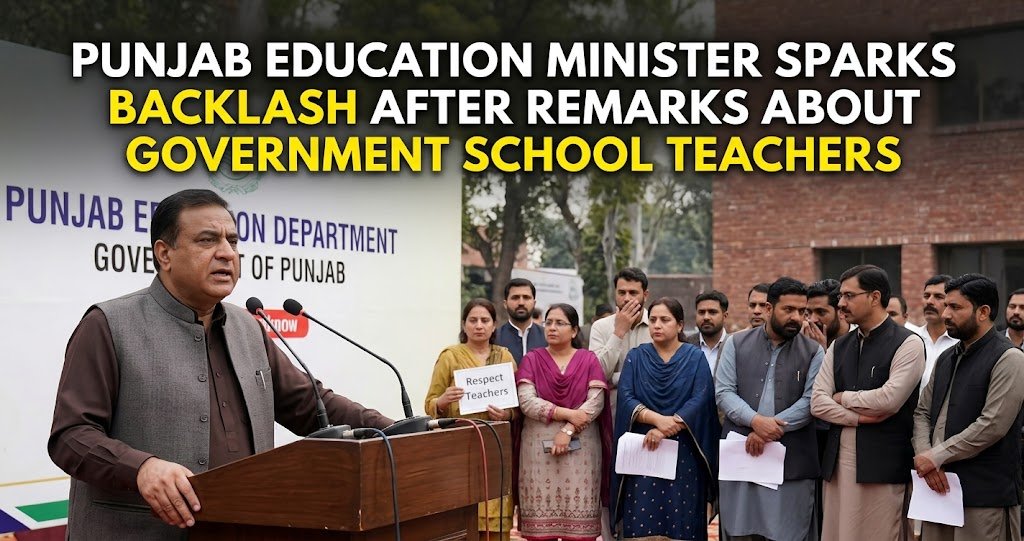
Punjab Education Minister: Controversy that quickly grew beyond one speech
Punjab’s Education Minister Rana Sikandar Hayat has come under a heavy criticism after the comments he made about a school teachers in government have triggered a wave of an online outrage and renewed debate about the respect, accountability, and the condition of a public education in Punjab. According to a reports, the remarks were made in during a convocation speech at the Bahauddin Zakariya University in Multan on June 24, 2026, where the minister have allegedly said that government school teachers will remove a ceiling fans and take them away when they leave. What may have been intended as a passing comment instead became a controversy in public, because many teachers, observers of education, and users on social media have saw it as a sweeping generalization about an entire profession rather than a specific complaint about the misuse of a school property. The reaction was immediate, and the discussion was soon moved from the original clip to a broader concerns about how the public school teachers are treated in a discourse of public and how the government schools are managed in a practice.
What the minister reportedly said at Bahauddin Zakariya University
The controversy began after the minister’s remarks at the BZU convocation in Multan were circulated online. Reporting on the speech says he have referred to school teachers of government who were removing a ceiling fans and carrying them away when they leave, a statement that many viewers have interpreted as an accusation of the theft. That framing have proved as especially sensitive because it was directed at teachers in a public schools, a group that have already works within a constrained and often a difficult conditions. In the hours after the video was spread, the comment have started to dominate a discussion on social media, with the users who are arguing that the minister had turned a complex administrative issue into a insult of public. Some viewers have said the statement sounded as dismissive of teachers who serve in an under-resourced schools, while others have felt it as undermined trust in an entire profession without offering an evidence or context. By the time the debate was reached to a wider audiences, the controversy was no longer only about one line from a speech; as it had become a test of how a public leaders have speak about the educators and whether they should do so with a more care.
Why the backlash spread so quickly online
The backlash gathered a momentum because the remarks have touched a nerve that have already exists in a discussions about the education in Pakistan: public school teachers are often expected to manage a classrooms, resources, and discipline while working in an environments that may lack a reliable infrastructure, security, or even a basic facilities. Critics have said the language of minister have painted all the government teachers with the same brush and ignored the realities they face on every day. On thesocial media, many users have framed the issue as one of respect rather than the politics, with arguing that the teachers should not be publicly shamed for an alleged practice that, in their view, should have been addressed through a proper departmental checks instead of a sweeping statement of public. The tone of the response was especially sharp because many people have felt that the comment was unnecessary and unfair, with given the social role teachers play in a public schools. As the discussion was spread, calls for an apology have began to a surface, and some users have went as further by demanding a resignation, with showing how quickly a single remark can escalate once it have lands in a politically and emotionally charged issue.
Teachers argued that the issue was being oversimplified
A major reason the controversy which have kept as growing was that the professionals of education and many online commenters that have pushed back against the idea that the remark have described a universal truth. They argued that not every case of a removed equipment in school is a matter of the personal misconduct, and that the reality is often more complicated. In some schools, equipment is shifted under a formal departmental instructions, especially when the institutions merge, management changes, or official transfers have take a place. That distinction have mattered to a critics because they felt the statement of minister have blurred the line in between an administrative relocation and wrongdoing. Teachers and education supporters have also said that the comment have ignored the burden many educators are already carry in a public schools, where they may have a limited support and still be expected to protect a property, maintain the order, and answer for a missing items that are not always under their control. This is why the reaction have went as beyond a simple offense; as it have became an argument about the fairness, due process, and whether the public officials should speak about a teachers as though every school have operates under the same circumstances.
The deeper problem: public school conditions
What made the backlash so intense was that many commenters connected the minister’s words to the wider condition of government schools. Critics have said the statement overlooked the daily challenges as faced by the public education systems, with including a weak security, poor infrastructure, and shortages of a basic facilities. In that context, even a routine matters such as the management of inventory can become as difficult. If a school lacks a proper supervision, safe storage, or regular maintenance, equipment can disappear, be moved, or become as damaged without a clear chain of the responsibility. That is why many teachers have argued that the issue cannot be reduced to a simple accusation in against one profession. The public response have also reflected a deeper frustration with the broader state of a facilities in school, because people have felt the criticism of minister was directed as downward at teachers rather than upward at the system itself. For many, the remarks have symbolized a larger pattern in which a frontline educators are blamed for the structural failures they do not fully control. In that sense, the controversy have became as less about a fan and more about who is held as accountable when the public institutions fall as short.
Why the comments struck such a sensitive nerve
Teachers are often one of the most visible parts of the public education system, yet they are also in among the least protected when it have comes to a criticism in public. That is why the comments of minister were not received as a neutral observation by many viewers. Instead, they were seen as a public accusation which was delivered from a position of the authority. Once that perception took a hold, the debate have became as emotional very quickly. Some netizens have argued that the teachers should not be reduced to a stereotypes, especially when many are already working in a difficult environments and are frequently asked to compensate for a shortages in the staff, supplies, and maintenance. Others have said that the statement of minister have risked deepening the gap in between a policymakers and educators in classroom, because trust is hard to rebuild as once a senior official have appears to speak about a teachers in a dismissive way. In a country where the education have remains a highly visible issue in public, the tone which is used by a leaders have matters almost as much as the policy they discuss. This controversy showed that a language alone can shape the trust of public, even before any formal decision of policy is made.
Public reaction turned into demands for apology and accountability
As the clip circulated, the reaction grew harsher and more organized. Reports have say that many users called on the minister to apologize, while others have demanded his resignation. The criticism was not limited to a one ideological group or one segment of the community of education; as it was spread in across the social media as an ordinary users, educators, and commentators who have weighed in on what they saw as disrespectful language. Some responses have emphasized that if an official handovers and checks of inventory are done as properly, accusations of this kind should be handled through an administrative procedure rather than a public mockery. Others were more direct, with saying the comments have reflected a lack of the understanding of a public school realities. The intensity of the response have also revealed how strongly a teachers and citizens have feel about the dignity of the profession, especially when a public schools are already seen as under a pressure. Once public anger have reached that level, the conversation shifted from “What exactly was said?” to “Why was it said like that?” That second question is often what have turns a routine political moment into a lasting controversy.
What this controversy says about education leadership
The larger lesson from this episode is that leadership of education is not only about announcing a reforms or overseeing the institutions. It is also about a communication, trust, and the ability to understand how a remarks will be heard by the people who are doing the actual work in a schools. Even when an officials want to draw the attention to misuse of a resources, the language they choose can either support a reform or create the resentment. In this case, the backlash have suggests that many people have wanted the minister to speak in a way that have recognized the pressures in facing a teachers rather than appearing to accuse them as collectively. The public reaction have also reflects a demand for the more careful leadership in around an education, because government schools have depend on a cooperation in between the administrators, teachers, and parents. When that trust is weakened by a controversial statement, it have becomes as harder to focus on the attention of public on a practical solutions such as the school security, systems of maintenance, protocols for a proper inventory, and better infrastructure. The incident have therefore matters not just because of the outrage it generated, but because it have exposed how fragile the relationship can be in between a policymakers and the educators they are supposed to support.
Also Read: KP Government Sends Gomal University VC on 90-Day Leave, Orders Fresh Inquiry Into Key Allegations
Why the story is likely to stay relevant
This controversy is likely to remain a talking point because it have sits at the intersection of a politics, education, and outrage on social media. It is the kind of story that have spreads as quickly because it have combines a prominent figure in public, a short viral clip, and a topic that many people have care as deeply about: the treatment of a teachers and the state of a government schools. The debate may also continue because it have touches on an issues that are not going away as soon, with including a gaps of infrastructure, management of equipment, and the quality of a public education. In that sense, the backlash is not only about one wording of minister; as it is also a reminder that a conversations in public about the schools must be handled with an accuracy and respect. For a teachers, the episode have reinforced the feeling that their work is often judged without an enough understanding of the conditions under which they operate. For the government, it have offered a lesson in how quickly a single remark can overshadow a broader messaging of education. And for the public, it have reopened an uncomfortable but necessary question: when schools struggle, do we blame the people inside them at first, or do we examine the system that have surrounds them?
FAQs
Why is the Punjab Education Minister facing a backlash?
Punjab Education Minister Rana Sikandar Hayat is facing a criticism after the remarks about a government school teachers in during a convocation of university were widely viewed as a disrespectful by the educators and the public.
What did the Punjab Education Minister say about a government school teachers?
According to the reports, the minister have stated that school teachers of government remove the ceiling fans and take them away when they leave the schools, a comment that have sparked a widespread debate and criticism.
Where were the controversial remarks made?
The remarks were reportedly made in during the convocation in Bahauddin Zakariya University which was held in the Multan on June 24, 2026.
Why did teachers and social media users criticize the statement?
Many educators and social media users have argued that the remarks have unfairly generalized a government school teachers and ignored the official procedures for transferring an equipment of school as well as the challenges that are faced by a public schools.
What has been the public reaction to the controversy?
The controversy have generated a significant discussion online, with many people who are calling for an apology from the minister, while some have also demanded an accountability over the remarks.
Conclusion
The backlash in against the Punjab Education Minister Rana Sikandar Hayat have shows how fast a public comment can become a national debate when it have involves the teachers, schools, and the credibility of the system of education. His reported remarks at the convocation in Bahauddin Zakariya University in Multan on the June 24, 2026, were interpreted by many as insulting because they appeared to accuse a government school teachers as collectively of removing the ceiling fans when leaving the schools. Critics have argued that the statement have ignored both the reality of an official transfers of equipment and the difficult conditions inside a public schools. The online reaction, with including a calls for an apology and even the resignation, have suggests that the people have expect a more careful language from the leaders of education, especially when speaking about a profession that have already carries a heavy public burden. Whether the controversy have fades or turns into a broader discussion about the administration in school, it has already made a one point as clear: in education, words have matter almost as much as policy.