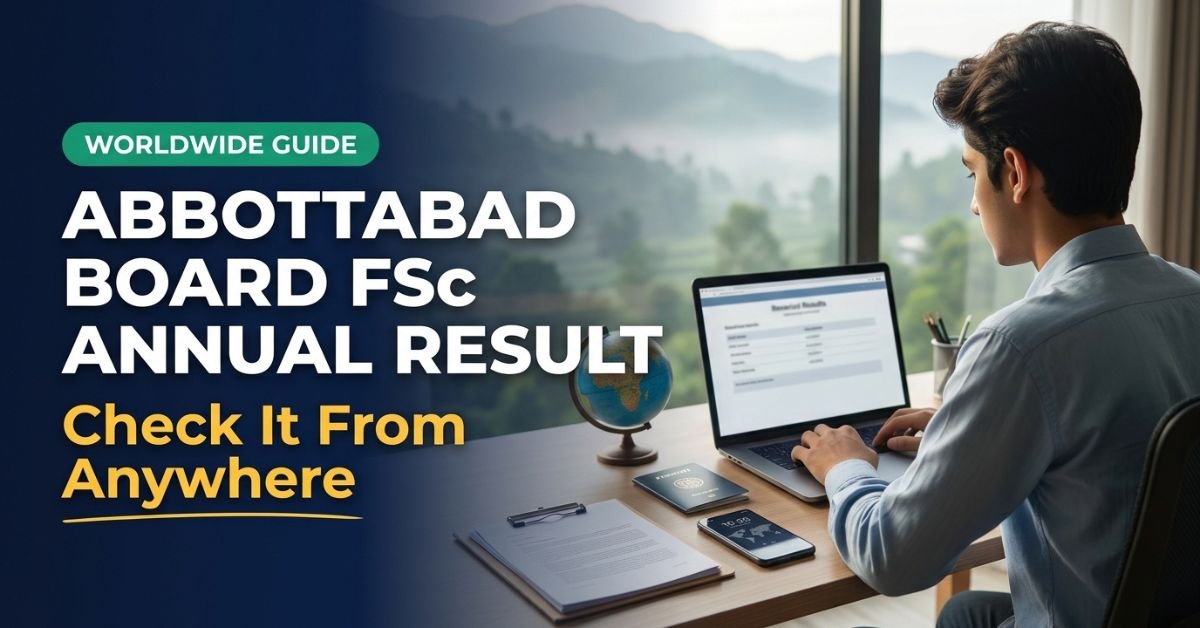
Abbottabad Board FSc Annual Result: How To Check It From Anywhere In The World
Ask anyone who has lived through a Pakistani result day from another country, and they’ll describe the same slip. They read “10 a.m.” on the announcement and set an alarm for 10 a.m. where they live. By the time a father in Toronto or a sister in Sydney opens the page, the student in Abbottabad has already seen the marks, shared them, and started worrying about admissions. The abbottabad board fsc annual result belongs to Pakistan’s clock, and everyone following it from abroad needs to plan around that.
Here is the short version. The result is released on the official website of the Board of Intermediate and Secondary Education (BISE) Abbottabad. To see it, open the results section and choose the intermediate (HSSC) level. Then select the relevant year and annual session, type the candidate’s roll number and search. Only the board’s own announcement fixes the release date.
For readers unfamiliar with the system: FSc (Faculty of Science) is the science stream of Pakistan’s two-year Higher Secondary School Certificate, taken in grades 11 and 12. It sits at roughly the same point in a student’s education as A-levels in Britain or the final years of high school in North America. That is why the result matters well beyond Pakistan.
The eight steps below walk through the whole journey in order. Each finishes with one small task to complete before you continue.
Confirm The Result Is Really Out
BISE Abbottabad has run secondary and intermediate examinations for the Hazara region since 1990. Its colleges and candidates come from districts such as Abbottabad, Haripur, Mansehra, Battagram and Kohistan. Like every Pakistani board, it announces a result formally before any marks can be searched. That announcement, published by the board itself, is the only schedule worth trusting.
Plenty of websites post confident “result dates” weeks in advance. Some roll last year’s timetable forward. Others simply guess. A date becomes real only when the board states it.
Now the clock. Pakistan Standard Time runs five hours ahead of UTC all year round, with no daylight saving shift. A release at 10 a.m. in Abbottabad falls at different local times around the world:
| City | Local Time |
|---|---|
| Doha | About 8 a.m. |
| Kuala Lumpur | About 1 p.m. |
| Berlin | Early morning (6 or 7 a.m., depending on the season) |
| Sydney | Mid-afternoon |
| Toronto | Around midnight or 1 a.m. |
Families spread across continents should agree beforehand on who checks first.
Pakistani boards often recognise top performers at a short ceremony before general results open. News of position holders can therefore appear slightly ahead of individual searches. An empty search in that gap is normal, not a sign of a problem.
Keep Your Roll Number And Details Close
The board’s system finds a record through the roll number, which is printed on the slip issued before the exams. Without it, checking online is almost impossible. Put the slip somewhere it won’t get lost, because you’ll need it again for re-totaling requests and for some admission forms.
When relatives abroad want to follow along, the student should send the roll number to them directly, not through a crowded family group or a public post. Anyone holding a roll number can open that candidate’s marks. Treat it the way you would treat a bank reference.
If the slip has gone missing:
- College students: ask the examination office, which keeps candidate records.
- Private candidates: reach the board through the contact details on its official site.
- Everyone: avoid anyone offering a “shortcut” for a fee. There isn’t one, and results open to everyone together.
Check Your Abbottabad Board FSc Annual Result Online
Once the board has announced the result, visit its official website and head to the results area. The form normally asks for four things:
- The examination level. Intermediate is usually listed as HSSC.
- The year.
- The session, which is the annual examination for regular candidates.
- The roll number.
Submit it, and the subject-wise marks appear on screen.
A few habits make result day smoother, wherever you are:
- Use a current browser. Chrome, Firefox, Edge and Safari all work well, but switch off data-saving or simplified viewing modes, which can stop the form from loading properly.
- If the page stalls, try a different browser. This is more effective than reloading over and over.
- Wait out the rush. The opening hour is always the busiest, so patience often works better than persistence.
Readers in distant countries may find the site slower than usual. That is normal when servers far away are handling a flood of visitors. Trying again after Pakistan’s morning peak usually solves it.
BISE Abbottabad HSSC Result: First Year And Second Year
Students in both the first year (Part I) and the second year (Part II) of FSc generally check through the same intermediate option. The two parts are not always released on the same day. Second-year results often take priority because university admissions depend on them. If your part isn’t available yet, check the board’s announcement to see which classes are covered.
SMS Services And Result Gazettes
Text-message result services have been offered by Pakistani boards before, but they typically run only on local mobile networks. Someone checking from Dubai, Manchester or Houston usually can’t use them. Short codes also change, and codes copied across websites are often out of date.
Result gazettes, the long lists covering many candidates, are mostly useful to schools and colleges. If you use one, make sure it came from the board, since altered copies do circulate.
Go Through Every Line Of The Result
A total tells you how the year went. The details tell you whether the record is right. Check each of these carefully:
- The candidate’s name and father’s name.
- The roll number.
- The academic group: Pre-Medical, Pre-Engineering, Computer Science, Humanities or another stream.
- The marks for each subject.
- The practical marks in science subjects, which are easy to overlook.
For readers outside Pakistan, one point often helps. Pakistani boards generally set the passing threshold at 33 percent of each subject’s total, far lower than many foreign systems. A pass on a Pakistani result does not automatically meet a foreign university’s minimum, which is usually a much higher overall percentage.
Name spelling deserves special attention. If the name on the result differs from the passport by even one letter, visa officers and foreign admissions teams may ask questions. The sooner a mismatch is reported, the simpler the correction.
The status line matters too. A result may show a pass, a failure in one or more subjects, a hold for administrative reasons, or a case flagged for alleged unfair means. Each outcome has its own process, explained in the steps that follow.
Keep that distinction in mind. The web result is an early notice. The official marks certificate issued by the board is the document that institutions, embassies and employers ultimately rely on. Any error on the web page should be fixed before that certificate is printed.
Weigh Up A Re-Totaling Request
Boards in Khyber Pakhtunkhwa usually open a re-totaling window shortly after results are published. The board sets the fee, the deadline, the eligibility and the application method in an official notice. Read that notice rather than relying on what worked for an older sibling, because the details can change.
Re-totaling is essentially an accuracy check. The board confirms that:
- every question was marked,
- the marks were added correctly,
- the right total reached your result.
It is not normally a full re-evaluation of how well you answered. It works best when a number looks wrong, not merely lower than hoped.
It is usually worth applying when:
- a subject shows zero or a figure far below your ability,
- one paper is dramatically out of line with the rest,
- you missed a pass or an admission threshold by a tiny margin.
If the marks broadly match your own expectation, the fee and the waiting time may bring little benefit.
Students who are overseas, or whose families are, should check early whether any part of the application must be completed in Pakistan, through the college or in person. Re-totaling windows tend to be short. Line up a trusted helper before the deadline rather than after it.
Prepare For Annual-II If A Subject Is Pending
Failing a subject is frustrating, but it rarely costs a full year. Pakistani boards run a second annual examination, often called Annual-II or the supplementary exam, so students can clear subjects they didn’t pass. Depending on the board’s rules, some students also use it to try to improve their marks.
The rhythm is broadly similar each year:
- Admission for the second exam opens a few weeks after the main result.
- The papers take place later in the year.
- Results arrive some months afterwards.
The board’s current notice sets the exact dates, fees and conditions, so check it rather than assuming.
Students aiming for universities abroad should talk to admissions offices early. Many institutions have handled pending results before. Some will defer an offer or accept a later start if you explain clearly when the supplementary result is due.
Results flagged for unfair means go through a separate review, usually by a board committee, with decisions announced officially. If your result carries that status, follow the board’s instructions exactly and keep copies of everything you send.
Turn The Result Into An Admission, Anywhere
For second-year students, the result is where the next chapter starts. Pakistani universities often open admissions around result season, and many let students apply with a “result awaited” status and add marks later. Professional programmes such as medicine and engineering typically combine intermediate marks with an entry test score. Keep your printout close for those applications.
Applying abroad brings a different checklist. Universities in Europe, North America, Australia, East Asia and the Gulf each assess Pakistani qualifications in their own way:
- Some accept FSc directly for undergraduate study.
- Others set high percentage requirements or ask for an English language test.
- Some place applicants on a foundation year first.
- Many international offices issue conditional offers based on first-year marks while the final result is pending.
In several countries, independent credential evaluation agencies compare foreign qualifications with the local system. They usually want official documents, not screenshots, so build in time for that.
Abbottabad Board 12th Class Result And Deadlines Across Countries
University calendars don’t pause for any board’s timetable. Northern-hemisphere universities often close applications months before Australian or Gulf institutions do.
Make a simple planning sheet with these columns:
- institution,
- country,
- application deadline in local time,
- whether pending results are accepted,
- documents required.
Complete it before the result arrives, so you can apply the moment marks are available.
Protect Your Documents For The Years Ahead
An on-screen result opens doors for a few weeks. Official documents keep them open for years. Store your roll number slip, registration details, result printout and later your official marks certificate in one folder. Keep scanned copies in secure online storage as well.
Anyone planning to use the qualification abroad should expect verification. Intermediate certificates from Pakistan are commonly attested by the Inter Board Committee of Chairmen (IBCC). IBCC can also issue equivalence certificates for certain purposes. Many destination countries then ask for an apostille, which Pakistan’s foreign ministry issues. Some countries still require embassy legalisation instead.
Rules vary by country and change over time. Confirm exactly what your university or embassy expects before starting.
Students moving between boards or institutions inside Pakistan may also need a migration certificate from BISE Abbottabad. For corrections, missing papers or anything unclear, use the contact channels on the board’s official website. Keep a note of every request, including the date you made it.
Printable Checklist
- Rely only on the board’s official announcement for the release date
- Convert the release time from Pakistan time to your local time
- Keep the roll number safe and share it privately
- Use an up-to-date browser with data-saving switched off
- Save a screenshot and printout as soon as the result loads
- Check the name, father’s name, group, subject marks and practicals
- Report any mistake to your college or the board quickly
- Read the re-totaling notice and note its deadline
- Plan Annual-II subjects if anything is pending
- Begin admission applications and document attestation early
What To Do Next
- Today, bookmark the board’s official website and agree within your family on who checks the result, and when.
- This week, fill in your planning sheet with local and international deadlines.
- On result day, check only through the official website and save a copy immediately.
- Within two days, decide whether re-totaling makes sense and arrange local help if you’re abroad.
- Within a month, start IBCC attestation and any apostille process if you plan to study overseas.
Summary Table
| Question | Short Answer |
|---|---|
| What is FSc? | The science stream of Pakistan’s two-year intermediate (grades 11–12) |
| Who releases the result? | BISE Abbottabad, through its official website |
| What do I need to check it? | Roll number, year and annual session |
| What time zone applies? | Pakistan Standard Time, UTC+5, all year |
| Can I check it abroad? | Yes, online; local SMS services usually won’t work |
| Is the web result official proof? | No; the board’s marks certificate is |
| What if a subject is failed? | Sit the Annual-II (supplementary) exam |
| Using it overseas? | IBCC attestation, often followed by an apostille |
Key Takeaways
- Trust only the board’s announcement for the release date, and read it in Pakistan time.
- A roll number is personal information, so share it carefully.
- Check every detail on the result, especially name spelling and practical marks.
- Re-totaling suits results that look wrong, not results that simply disappoint.
- Students heading abroad should start attestation and admission planning early.
Frequently Asked Questions
What does FSc mean on a Pakistani result?
FSc stands for Faculty of Science. It is the science stream of the two-year Higher Secondary School Certificate, covering grades 11 and 12. It is broadly comparable in stage to A-levels or the final years of high school.
What is the passing mark for FSc subjects?
Pakistani boards generally require 33 percent of a subject’s total marks to pass. Universities, especially abroad, usually ask for much higher overall scores.
Can parents living abroad handle result-related work for their child?
Parents can check the result online from any country. Tasks such as re-totaling or collecting documents may require someone in Pakistan, so check the board’s notice and arrange a trusted helper.
How long does re-totaling take?
It varies from year to year and depends on the number of requests. The board’s official notice and its later announcements are the best guide.