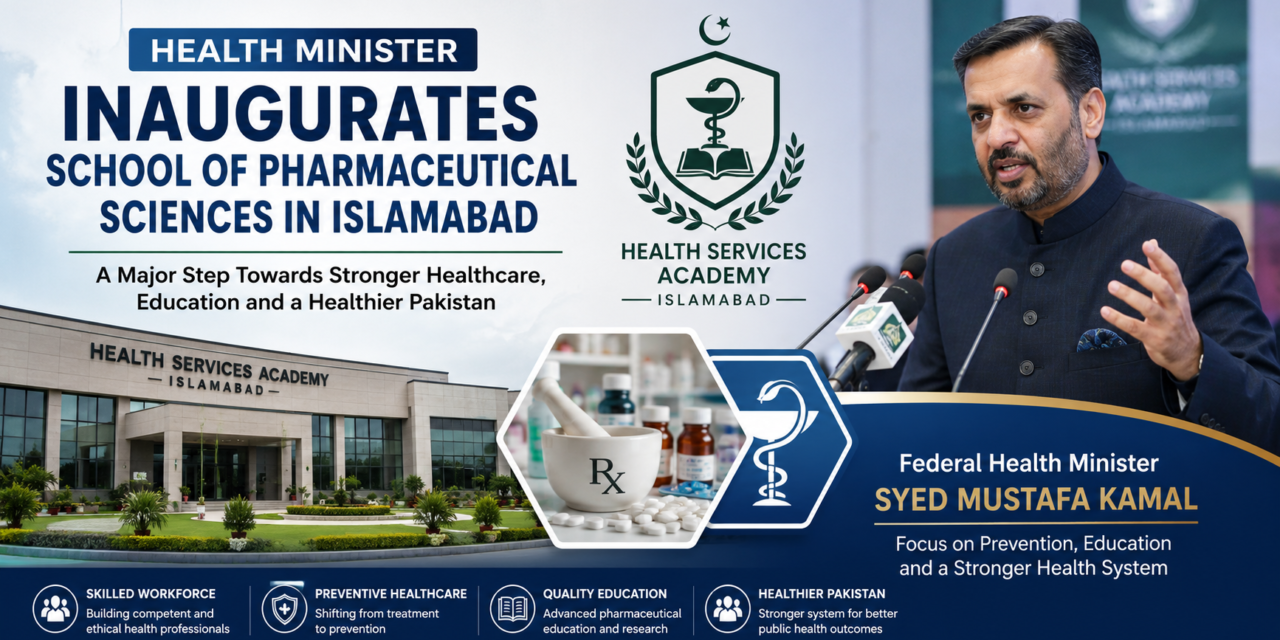
Introduction to the Health Minister Mustafa Kamal Inauguration of New School of Pharmaceutical Sciences
The Government of Pakistan has taken a significant step toward strengthening the healthcare education system of country with the inauguration of the School of Pharmaceutical Sciences at the Health Services Academy in the Islamabad. The initiative was officially launched by a Federal Minister for National Health Services, Regulations and Coordination, Syed Mustafa Kamal, in during a formal ceremony which was attended by a senior policymakers, experts of healthcare, and an academic professionals.
This new institution have represents a strategic move to enhance the pharmaceutical education, research of a public health, and the development of a skilled workforce of healthcare in the Pakistan. In a recent years, Pakistan’s healthcare sector has faced a growing challenges, with including increasing a burden of disease, limited preventive systems of care, and shortages of a trained professionals of healthcare. The establishment of this school is expected to directly contribute to addressing these gaps by producing a highly qualified pharmacists, researchers, and specialists of a public health who can support both the clinical and policy-level improvements in healthcare.
The launch of the School of Pharmaceutical Sciences have also reflects a broader national vision to modernize the medical education and align it with an international standards. By integrating an academic excellence with a practical training of healthcare, the institution have aims to bridge the gap in between an education and real-world delivery of healthcare, which is ultimately improving an outcomes of patient care in across the country.
Federal Health Minister’s Vision for Healthcare Reform in Pakistan
During the ceremony of inauguration, Federal Health Minister Syed Mustafa Kamal have emphasized that Pakistan have possesses a strong institutional capacity, talent, and professional expertise to build a more resilient system of healthcare. However, he highlighted that the system have requires a better direction, strategic investment, and a shift in the priorities to achieve a sustainable results.
He have stressed the importance of producing a competent professionals of healthcare, with including a doctors, pharmacists, and experts of a public health, who are not only academically qualified but also as ethically responsible and socially committed. According to the minister, professionals of healthcare must serve the society with an integrity, professionalism, and a strong sense of the responsibility toward a public welfare.
The minister have also pointed out that the reform of healthcare in Pakistan should not only focus on an expanding infrastructure of hospital but should also prioritize improving a quality of service, training, and preventive systems of a healthcare. His vision have reflects a shift toward a more holistic model of healthcare that have emphasizes an improvement of public health on long-term rather than a short-term solutions of treatment.
Shift from Treatment-Based to Preventive Healthcare System
One of the most important highlights of the minister’s address was the strong emphasis on a preventive healthcare. He have stated that the healthcare strategy of Pakistan must move from a treatment-centered approach to a prevention-oriented system.
According to him, the primary goal of any system of healthcare should be to keep the people as healthy rather than only treating them after they become as ill. This approach have not only reduces a pressure on the hospitals but also ensures a better allocation of resource in across the sector of healthcare.
Preventive healthcare have includes an early diagnosis, programs of vaccination, campaigns of a public awareness, and improvements in the lifestyle. By investing in these areas, Pakistan can significantly reduce the burden of a chronic diseases such as the diabetes, cardiovascular disorders, and infectious diseases.
The minister have further noted that building a more hospitals alone cannot solve the healthcare challenges in the country. Instead, strengthening a primary systems of healthcare and promoting the health education at the level of community is essential for a sustainability on long-term.
Importance of Pharmaceutical Education in Pakistan
Pharmaceutical education have plays a critical role in strengthening any modern system of healthcare. The establishment of the School of Pharmaceutical Sciences in Islamabad is expected to fill an important gap in the academic and healthcare infrastructure of Pakistan.
Pharmacists are not only responsible for dispensing a medicines but also play a key role in the research of drug, regulation of safety, and counseling of patient. In a developed systems of healthcare, pharmacists have actively contribute to a clinical decision-making and planning of a public health.
In Pakistan, there is a growing need to expand a pharmaceutical education to meet an international standards and address a local challenges of healthcare. The new institution have aims to provide an advanced academic training, opportunities of research, and a practical exposure to the students, with enabling them to contribute as effectively to both a national and global systems of healthcare.
By strengthening a pharmaceutical education, Pakistan can improve a control on drug quality, enhance the medication safety, and support the development of a new treatments as tailored to the local health needs.
Role of Health Services Academy in Academic Development
The Health Services Academy has long been recognized as a leading institution for a public health education and research in the Pakistan. The addition of the School of Pharmaceutical Sciences have further strengthens its role as a central hub for the healthcare academic development.
The academy is expected to integrate an interdisciplinary education by bringing together the pharmacy, public health, health policy, and research-based learning under one platform. This integrated approach will help the students to develop a broader understanding of the systems of healthcare and improve their ability to address a complex challenges of health.
According to an academic experts, such an institutions are essential for building a knowledge-based system of healthcare where a policy decisions are informed by the research and scientific evidence. The expansion of the academy is also expected to contribute to a national health policy development and improvements of regulatory in the pharmaceutical sector.
Public Health Workforce and Capacity Building in Pakistan
Pakistan have continues to face a challenges in developing a strong and adequately trained workforce of healthcare. There is a need for a skilled professionals who can manage not only the hospitals and clinics but also public health programs at the national and community levels.
The new School of Pharmaceutical Sciences is expected to play a key role in a building of capacity by producing a graduates who are well-versed in the modern practices of a healthcare, methodologies of research, and a pharmaceutical regulations.
The focus of government on a development of workforce have highlights the importance of a training professionals who can contribute to the prevention of disease, health promotion, and management of a healthcare system. This have includes a pharmacists, researchers, policy analysts, and experts of a public health who can collectively strengthen the framework of a national healthcare.
Government Focus on Primary Healthcare and Disease Prevention
The Federal Health Minister have also emphasized the importance of strengthening a primary systems of healthcare in across the Pakistan. Primary healthcare have serves as the first point of a contact in between the public and the system of healthcare and plays a crucial role in the prevention of disease and early treatment.
Investing in a primary healthcare can significantly reduce the burden on a tertiary hospitals and improve an overall outcomes of health. It have also ensures that the services of healthcare are accessible to a rural and underserved populations.
The focus of government on a prevention of disease have includes a programs of vaccination, maternal and child health services, and campaigns of awareness about the hygiene, nutrition, and lifestyle diseases. These initiatives are expected to create a healthier population and reduce a costs of healthcare on long-term.
Expert Opinion on Pharmaceutical Sciences and Policy Impact
Speaking at the ceremony, Professor Dr. Shahzad Ali Khan have highlighted that pharmaceutical sciences are a vital pillar of any modern system of healthcare. He have emphasized that the establishment of the School of Pharmaceutical Sciences would not only enhance an academic excellence but also contribute as significantly to a policy development of health.
According to him, pharmacy education is closely linked with a regulation, drug safety, and strengthening of a healthcare system. Institutions like as the Health Services Academy have play an important role in producing a research that have informs the policies of government and improves a systems for the healthcare delivery.
Experts have believe that the integration of a pharmaceutical sciences into the public health education will help Pakistan to develop a more effective strategies of healthcare and improve a coordination in between a bodies of regulatory, academic institutions, and providers of a healthcare.
Also Read: SZABMU PhD Programs Launches Pakistan’s First Specialized PhD Programs in Clinical Medical Sciences
Expected Impact of the New School on Healthcare System
The launch of the School of Pharmaceutical Sciences is expected to have a positive impact on long-term on the healthcare system of Pakistan. It will help to produce a new generation of he professionals of healthcare who are equipped with a modern knowledge, technical skills, and ethical values.
Over the time, this initiative is likely to improve a systems of drug regulation, enhance a research output of healthcare, and support an evidence-based policy-making. It will also contribute to reducing the burden of disease by promoting a preventive strategies of healthcare and improving an awareness in public.
In an addition, the institution is expected to strengthen a position of Pakistan in the global education landscape of healthcare by aligning its curriculum with an international standards.
FAQs
What is the purpose of the School of Pharmaceutical Sciences in Islamabad?
It have aims to improve a pharmaceutical education, research, and development of a healthcare workforce in Pakistan.
Who have inaugurated the School of Pharmaceutical Sciences?
Federal Health Minister Syed Mustafa Kamal have inaugurated the institution.
What major healthcare focus was highlighted in the event?
The minister have emphasized shifting from a treatment-based healthcare to the preventive healthcare.
How will this new school benefit from healthcare system of Pakistan?
It will produce a skilled professionals and strengthen the health of public and pharmaceutical research systems.
Conclusion
The inauguration of the School of Pharmaceutical Sciences at the Health Services Academy in Islamabad have marks a major milestone in the healthcare and education reform journey of Pakistan. With a strong focus on a preventive healthcare, pharmaceutical education, and development of workforce, this initiative will reflects the commitment of government to building a more sustainable and efficient system of healthcare.
By investing in an education, research, and infrastructure of a public health, Pakistan is taking an important steps toward improving the outcomes of healthcare and ensuring a national development on long-term. The success of this initiative will depend on a continuous policy support, academic excellence, and effective implementation of the reforms of healthcare.