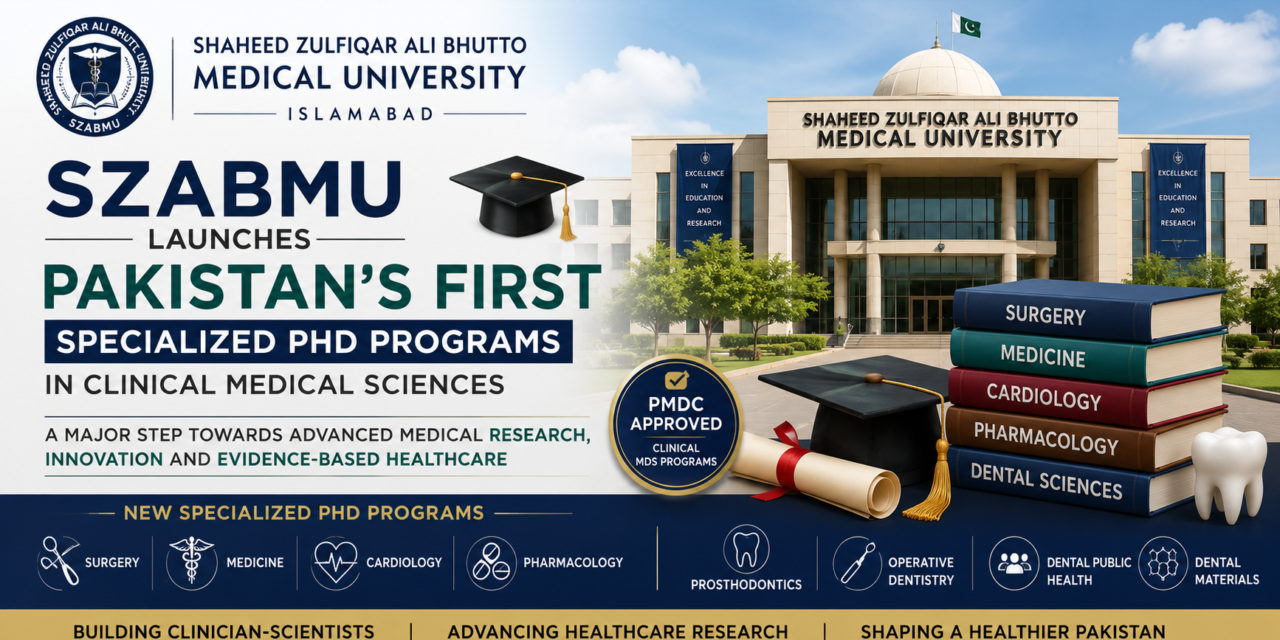
SZABMU PhD Programs: A Major Step in Pakistan’s Medical Education Landscape
Pakistan’s higher education and sector of healthcare has entered a new phase of an academic transformation as Shaheed Zulfiqar Ali Bhutto Medical University has officially announced the launch of a several specialized programs of PhD in a clinical medical and dental sciences. This development is being widely seen as a landmark initiative which is aimed at strengthening an advanced medical research, with improving an outcomes of healthcare, and aligning the academic structure of Pakistan with an international standards of the specialized clinical education.
For many years, doctoral education in the medical sector of Pakistan have remained as largely focused on a general disciplines such as the basic medical sciences, public health, or broad categories of a dentistry. However, the introduction of a highly specialized and standalone programs of a PhD in the fields like as Surgery, Medicine, Cardiology, Pharmacology, Prosthodontics, Operative Dentistry, and Dental Public Health have represents a significant shift toward the precision-based academic research and clinical specialization.
This move is not only an academic upgrade but also a strategic investment in the long-term healthcare capacity of Pakistan. By developing a clinician-scientists and research-driven medical professionals, the initiative is expected to improve an evidence-based treatment, development of policy, and innovation in a systems of healthcare delivery in across the country.
SZABMU’s Vision for Advanced Medical Research
The core vision which is behind the introduction of these new doctoral programs is to transform the medical education system of Pakistan into a research-oriented and globally competitive framework. The university have aims to bridge the gap in between a clinical practice and scientific research by encouraging the doctors and professionals of dental to pursue an advanced academic qualifications in their respective specialties.
Traditionally, medical professionals in the Pakistan have relied on a professional degrees such as the FCPS, MDS, or MD for a clinical advancement. However, these qualifications have often focus as more on a practice-based training rather than research-intensive academic development. The new programs of PhD have address this gap by integrating a methodology of scientific research, clinical innovation, and academic scholarship into a specialized fields of the medicine and dentistry.
The university has emphasized that these programs are designed to produce a new generation of the experts in healthcare who can not only treat a patients but also contribute to the medical research publications, clinical trials, and frameworks of a healthcare policy at the national and international levels.
Specialized PhD Programs Introduced
One of the most notable aspects of this initiative is the diversity and depth of a specialized fields which is included in the new doctoral structure. According to an official information, SZABMU has introduced a programs of PhD in the following areas:
- Surgery
- Medicine
- Cardiology
- Pharmacology
- Prosthodontics
- Operative Dentistry
- Dental Public Health
- Dental Materials
Each of these disciplines have represents a highly focused area of the medical or dental science, with allowing a scholars to engage in an advanced research which is tailored to a specific clinical challenges.
For example, the PhD in Cardiology is expected to focus on a diseases of cardiovascular, treatment innovation, and preventive strategies. Similarly, Pharmacology research may explore a development of drug, clinical trials, and pharmaceutical advancements that are relevant to both a local and global needs of healthcare.
In the field of a dentistry, programs like as the Prosthodontics and Operative Dentistry have aim to enhance a restorative techniques, applications of a material science, and patient-centered solutions of a dental care. These specialized tracks are expected to significantly improve the quality of a dental education and clinical outcomes in the Pakistan.
A Shift from Traditional to Specialized Doctoral Education
The introduction of these programs have marks a clear departure from the traditional doctoral models of education in Pakistan. Previously, most programs of PhD in the medical universities were broad in a scope, with often lacking a deep specialization in the clinical subfields. This limited the ability of a researchers to focus on the niche medical challenges that have require an advanced expertise.
With the new structure which was introduced by SZABMU, students and professionals will now have the opportunity to pursue a highly targeted paths of research. This shift is expected to enhance an academic productivity, increase the publications of research, and improve the representation of Pakistan in an international medical journals.
Moreover, the availability of a standalone PhD programs in a clinical disciplines is expected to attract not only a local scholars but also an international students and researchers who are interested in a specialized studies of healthcare.
Strengthening Evidence-Based Healthcare in Pakistan
One of the most significant expected outcomes of these PhD programs is the strengthening of an evidence-based practices of healthcare in Pakistan. Evidence-based medicine have relies as heavily on a high-quality research, clinical trials, and scientific validation of the methods of treatment.
By encouraging he doctors and dental professionals to engage in a structured research at the doctoral level, SZABMU is effectively contributing to the development of a system of healthcare that is more data-driven, scientifically validated, and patient-focused.
This is particularly important in developing a countries like as the Pakistan, where a systems of healthcare have often face a challenges such as the limited research funding, lack of a clinical innovation, and gaps in the medical knowledge dissemination. The introduction of a specialized programs of PhD can help to address these issues by creating a culture of stronger research within the medical institutions.
PMDC Approval and Institutional Development
In addition to launching new PhD programs, the university has also achieved a major milestone in academic recognition. The School of Dentistry at SZABMU has received an approval from the Pakistan Medical and Dental Council (PMDC) for its programs of a clinical MDS, with including the Orthodontics, Oral and Maxillofacial Surgery, Pediatric Dentistry, and Periodontology.
This approval not only validates the quality of an academic framework of SZABMU but also ensures that its graduates meet a national and standards of an international professional. It have also strengthens the credibility of the institution and enhances its role as a leading center for the medical education and research in a Pakistan.
The combination of a newly introduced programs of PhD and PMDC-approved positions in a clinical training programs such as SZABMU as a key player in shaping the future of a healthcare education in the country.
Bridging the Gap Between Clinical Practice and Research
One of the most important goals that are behind these newly introduced doctoral programs is to bridge the long-standing gap in between a clinical practice and medical research in the Pakistan. In many systems of a healthcare, with including developing a countries, doctors have often focus as heavily on a treatment of patient while activity of research have remains as limited to a small academic circle. The initiative by Shaheed Zulfiqar Ali Bhutto Medical University have aims to change this structure by integrating a research as directly into the clinical training at the highest academic level.
Through these specialized programs of PhD, medical professionals will now be encouraged to investigate a real-world clinical problems, develop the new approaches of treatment, and publish a research that have directly improves the patient care. This model is aligned with a global standards where leading a medical universities have actively combine a practice in hospital with an advanced laboratories of a research. As a result, Pakistan is expected to see a gradual improvement in the clinical innovation, better diagnostic methods, and more effective protocols of treatment in a various medical fields.
Role of Dentistry and Clinical Specialization
Dentistry has also received a significant attention in this new academic expansion. The inclusion of a specialized programs of PhD in the Prosthodontics, Operative Dentistry, Dental Public Health, and Dental Materials have highlights the importance of an oral healthcare as a core part of the overall medical development.
These programs are designed to go as beyond a traditional dental education and focus on an advanced scientific research in an areas such as the biomaterials, restorative techniques, and population-based strategies of an oral health. For an example, research in a Dental Materials may lead to the development of a stronger, more durable, and biocompatible dental solutions, while Dental Public Health have focuses on improving the awareness of an oral hygiene and preventive strategies at the level of community.
This academic diversification is expected to significantly enhance Pakistan’s dental healthcare system by producing experts who can both treat complex dental cases and contribute to scientific advancements in oral medicine.
Building a New Generation of Clinician-Scientists
A major long-term impact of these programs will be the development of a clinician-scientists, professionals who are equally skilled in a care of patient and scientific research. This dual expertise is highly valued in a modern systems of healthcare, especially in the countries that have aim to strengthen their infrastructure of a medical research.
By offering a structured pathways of PhD in the clinical disciplines such as a Surgery, Medicine, Cardiology, and Pharmacology, the university is creating an opportunities for the doctors to transition from a purely clinical roles into the positions of a research leadership. These individuals will play a key role in designing the clinical trials, with evaluating an effectiveness of treatment, and influencing a policy of healthcare at both the institutional and governmental levels.
Over a time, this will contribute to the establishment of a stronger culture of research within the hospitals and medical universities in across the Pakistan, with helping to elevate the global academic standing of country.
Alignment with Global Medical Education Trends
The introduction of these specialized doctoral programs have also reflects an important effort to align the medical education system of Pakistan with a global academic trends. In many developed countries, medical universities have already adopted a highly specialized structures of PhD that have focus on a niche areas of the clinical science rather than a broad general disciplines.
By introducing a standalone programs of PhD in the specific medical and dental fields, SZABMU is taking a significant step toward an international academic compatibility. This will not only benefit a local students but also open a doors for the international collaboration, joint projects of a research, and programs of an academic exchange.
Such an alignment is essential in the interconnected academic environment of today, where a medical research have often requires a cross-border cooperation and access to the global networks of knowledge.
Strengthening Healthcare Policy and Innovation
Another important outcome of these programs is their potential impact on a healthcare policy and innovation. Research conducted under these programs of PhD is expected to provide a valuable insights into the patterns of disease, effectiveness of a treatment, and challenges of a healthcare system in the Pakistan.
This evidence-based research can be used by a policymakers to design a better strategies of healthcare, allocate a resources as more efficiently, and improve an outcomes of the public health. For example, studies in the Cardiology may help to identify a rising trends in the cardiovascular diseases, while Pharmacology research can contribute to a safer and more effective drug usage policies.
In this way, the initiative of university have extends as beyond an academia and directly contributes to a national healthcare planning and innovation.
PMDC Recognition and Academic Credibility
The recent approval of a clinical MDS programs by the Pakistan Medical and Dental Council (PMDC) have further strengthens the credibility of an academic expansion of SZABMU. This recognition have ensures that all the programs of training have meet a strict national standards and maintain the assurance of quality in a medical education.
Programs such as the Orthodontics, Oral and Maxillofacial Surgery, Pediatric Dentistry, and Periodontology have now been officially validated, with allowing a graduates to pursue the professional careers with a recognized qualifications. This development have enhances trust in the academic framework of university and reinforces its position as a leading medical institution of education in the Pakistan.
Challenges and Future Outlook
While the introduction of a specialized programs of PhD is a major achievement, as it have also comes with a certain challenges. These have include the need for a highly qualified faculty of research, advanced infrastructure of a laboratory, sufficient funding for the clinical research, and strong collaboration in between a hospitals and academic departments.
However, if these challenges are effectively addressed, the long-term benefits are expected to be substantial. Pakistan could see a significant rise in the output of a medical research, improved standards of a healthcare, and stronger international academic recognition.
The future outlook of these programs is highly positive, as they are expected to attract a talented students, encourage an innovation, and create a sustainable model for the advanced medical education in the country.
FAQs
What new programs has the SZABMU introduced?
SZABMU has introduced a specialized programs of PhD in the clinical medical and dental sciences.
Which fields are included in the new programs of PhD?
The programs have include a Surgery, Medicine, Cardiology, Pharmacology, and several dental specialties.
Why are these programs of PhD important for Pakistan?
They strengthen a medical research, innovation, and evidence-based healthcare in the Pakistan.
Has SZABMU received any official approval for its programs?
Yes, PMDC has approved a several clinical programs of MDS which is offered by SZABMU.
Final Conclusion
The launch of a specialized PhD programs by Shaheed Zulfiqar Ali Bhutto Medical University have represents a transformative milestone in the medical and dental education system of Pakistan. By introducing a focused doctoral studies in the clinical disciplines, the university is not only expanding an academic opportunities but also strengthening the foundation of a healthcare research and innovation in the country.
With a PMDC-approved clinical programs, international-standard pathways of research, and a strong emphasis on an evidence-based medicine, SZABMU is positioning itself as a key driver of an academic excellence in the Pakistan. This initiative is expected to produce a new generation of the clinician-scientists who will play a vital role in improving a delivery of healthcare, advancing a medical knowledge, and shaping the future policies of healthcare.
Ultimately, this development have marks the beginning of a new era in the medical education landscape of Pakistan, one that is a more research-driven, specialized, and globally competitive.