Introduction: Pakistan Education Updates 2026 (2026 Overview)
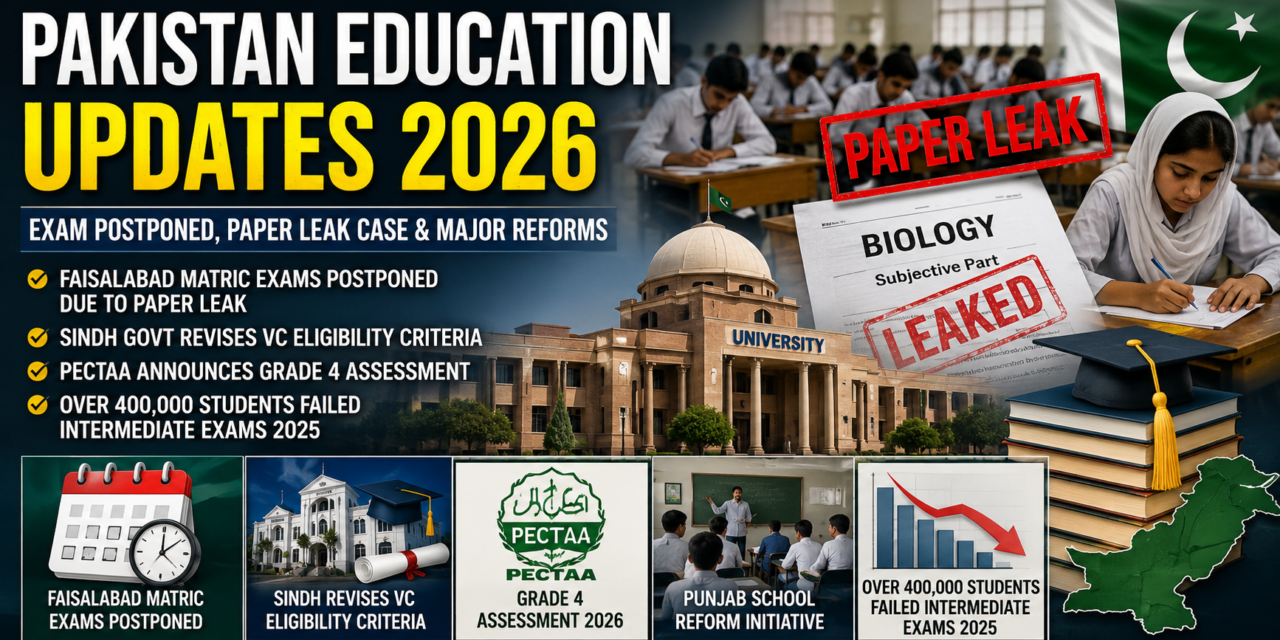
The education sector in Pakistan is going through one of its most critical phases in 2026, as a multiple developments have raised a serious concerns about the transparency in examination, administrative reforms, and an institutional performance in across the country. From an incidents of paper leak in the examinations of board to a large-scale policy changes in the universities and school systems, the entire academic structure have appears to be under a pressure. The latest updates from May 6, 2026, have highlight a several key events which is including the postponement of a matric exams in the Faisalabad, reforms in the university of Sindh’s as vice-chancellor appointment criteria, and the announcement of a province-wide Grade 4 assessment by PECTAA. These developments are not an isolated incidents but represent a broader challenges in the governance, exam security, and an educational quality assurance. At the same time, alarming statistics such as over a 400,000 students failing the intermediate exams in 2025 have further reflect the systemic weaknesses in a standards of teaching and methods of a student evaluation. This article have provides a detailed breakdown of all the major updates of education in Pakistan, analyzing their causes, impacts, and future implications for a students, teachers, and policymakers.
Major Education Developments in Pakistan (May 6, 2026 Overview)
The landscape of education in Pakistan has witnessed a multiple simultaneous developments that have reflect both the efforts of reform and systemic disruptions. On one side, provincial governments are introducing a new policies that are aimed at improving the governance, such as a rules of revised appointment for the vice chancellors of university in Sindh and large-scale student assessment programs in Punjab. On the other hand, unexpected disruptions like as postponements of exam and teacher boycotts have created an uncertainty in among the students. The decision of a Faisalabad Board to postpone Class 9 second-group examinations due to a reported paper leak of Biology has raised a serious concerns about the security protocols of examination. Meanwhile, Karachi University has faced an academic disruption due to the faculty protests and exam boycotts. Additionally, Punjab’s education department is moving as forward with outsourcing the middle schools under a initiative of broader reform, with aiming to improve the underperforming institutions. These developments have collectively show that the education system of Pakistan is currently undergoing a phase of transformation, but it is also facing an operational and credibility challenges that have require an urgent attention from the authorities.
Faisalabad Matric Exam Postponement Due to Paper Leak Incident
One of the most significant events in the recent education updates is the postponement of a matric examinations in the Faisalabad after a reported paper leak of Biology. The Faisalabad Board of Intermediate and Secondary Education have took this decision after a credible reports suggested that the examination paper had been accessed and circulated before the scheduled exam time. This incident have not only disrupted the academic schedule but also raised a serious questions about the integrity of the examination system in Pakistan. Students who are preparing for their exams were left as uncertain about the revised dates, which is causing a mental stress and academic disruption. Authorities have initiated an investigations to identify those who are responsible for the leak, which is including a potential involvement of staff or external networks. Such an incidents have highlight the long-standing weaknesses in a systems of paper distribution and protocols of security. The board has promised a stricter mechanisms of monitoring, digital tracking of the paper movement, and disciplinary action in against the individuals who were involved. However, repeated occurrences of a paper leaks in the various boards across Pakistan have continue to damage a public trust in the system of examination and raise a concerns about the fairness in an evaluation of student.
Sindh Government Revises University Vice-Chancellor Appointment Criteria
In a major policy shift, the Sindh cabinet has officially revised the criteria of eligibility for appointing a vice chancellors in the public universities. This decision is part of a broader effort to improve the governance, academic leadership, and an administrative efficiency in a higher education institutions. The new criteria have reportedly include a changes in the required qualifications, professional experience, and procedures of a selection, with aiming to ensure that only a highly qualified individuals are appointed to lead the universities. This reform is expected to bring a greater transparency into the process of selection, reducing a political influence and increasing the merit-based appointments. However, some experts of education have argue that a frequent changes in the eligibility rules may create an instability in the administration of university and delay in appointments, with affecting the institutional performance. Universities have play a critical role in the research, innovation, and skilled workforce development, and therefore quality of leadership have directly impacts the academic outcomes. The government of Sindh has stated that the reform is designed to align a local universities with the international standards, but its long-term effectiveness will depend on a consistent implementation and institutional support.
PECTAA Announces Grade 4 Large Scale Assessment (LSA-2026)
The Punjab Education Curriculum Training and Assessment Authority (PECTAA) has announced a province-wide Large Scale Assessment (LSA-2026) for the students of Grade 4, which is marking an important step toward evaluating a foundational outcomes of learning. This assessment have aims to measure a performance of student in the key subjects such as English, Mathematics, and Science in across a public schools in Punjab. According to an officials, the purpose of this initiative is not only to test the students but also to identify a gaps in the quality of teaching and curriculum delivery at the primary level. The data collected from this assessment will be used to improve an educational planning and programs of teacher training. While the initiative has been welcomed as a step toward an evidence-based reform of education, some teachers have expressed a concerns about the additional academic pressure on a young students. Education experts have believe that early-stage assessments can help to improve the outcomes of learning if implemented as correctly, but they must be designed in a student-friendly manner to avoid a stress and performance anxiety in among the children.
Karachi University Exam Boycott and Academic Disruption
Karachi University has recently faced an academic disruptions due to a boycott of examinations by a teaching staff, which has significantly affected the academic calendar. The protest have reportedly stems from an administrative grievances, workload concerns, and disagreements of an institutional policy. As a result, several scheduled examinations were delayed or postponed, with causing an inconvenience for the thousands of students. This situation have highlights the fragile relationship in between a faculty and administration in some institutions of a higher education in Pakistan. Students have expressed a frustration over the repeated delays, which impact their academic progress and future planning. Educational stakeholders have emphasize the need for a dialogue in between the representatives of faculty and management of university to resolve an issues in a timely and structured manner. Continuous disruptions in an academic schedules have not only affect the performance of student but also damage the credibility o af higher education institutions at both the national and international levels.
Punjab School Outsourcing and Education Reform Initiative
The Punjab School Education Department has announced a major reform initiative which is involving the outsourcing of a middle schools, which is expanding on an earlier policies of outsourcing for a primary schools. This new strategy is based on a 2025 census data and focuses on improving the underperforming institutions by handing their management over to a private or semi-private operators. Some of these schools may be converted into the “Nawaz Sharif School of Excellence” under a performance improvement model. The government have believes that outsourcing will improve an school infrastructure, teaching quality, and rates of a student enrollment. However, critics have argue that privatization of a public education may lead to an inequality and reduced access for a low-income families. The success of this initiative will depend on a proper regulation, transparency, and mechanisms of accountability to ensure that educational standards are maintained and improved rather than compromised.
Intermediate Exam Results 2025: Over 400,000 Students Fail
One of the most alarming statistics in a recent education updates is the failure of over the 400,000 students in the 2025 intermediate examinations in across the Pakistan. This high rate of failure has raised a serious concerns about the quality of an education at the college level. Experts have suggest that a multiple factors have contribute to this situation, which is including an outdated methods of teaching, lack of a student engagement, insufficient academic resources, and gaps in the curriculum design. The results have highlight the urgent need for a reforms in both the strategies of teaching and systems of an evaluation. Education authorities are now being urged to investigate a root causes and introduce the targeted interventions such as teacher training programs, curriculum modernization, and initiatives of a student support. Without a significant reforms, the trend of a high failure rates may continue, which is further affecting the skilled workforce development of country.
FAQ Section
Why were the Faisalabad Matric exams postponed in a 2026?
The exams were postponed due to a reported paper leak of Biology, with raising a concerns about the exam security.
What is the PECTAA Grade 4 assessment 2026?
It is a province-wide evaluation in Punjab to measure an outcomes of learning of Grade 4 students in the key subjects.
Why are so many students failing in an intermediate exams in Pakistan?
Poor preparation, outdated methods of teaching, and curriculum gaps are major reasons behind a high rates of failure.
What changes were made in the Sindh university VC appointments?
The Sindh cabinet revised a criteria of eligibility to improve the transparency and merit-based selection of a vice chancellors.
Conclusion: A System Under Pressure but Moving Toward Reform
The education updates of May 2026 have clearly show that education system of Pakistan is at a critical crossroads. While a significant reforms are being introduced at both the provincial and institutional levels, with recurring an issues such as the paper leaks, exam disruptions, and high rates of failure continue to challenge the credibility of system. The Faisalabad exam postponement, Sindh’s governance reforms, Punjab’s assessment programs, and Karachi University disruptions all have reflect a system that is trying to evolve but still struggling with a structural weaknesses. Moving as forward, consistent implementation of policy, improved examination security, and investment in a teacher training will be essential for an improvement in long-term. If properly managed, these reforms have the potential to significantly enhance the quality of an education in the Pakistan and restore a public trust in the academic institutions.