Introduction to HEC Pakistan AI initiative
The Higher Education Commission (HEC) of Pakistan has taken a significant step toward strengthening the position of country in emerging a technologies by launching a national-level initiative which is focused on an Artificial Intelligence (AI) and Robotics. In a rapidly evolving global digital economy where the AI is reshaping an industries, systems of governance, security frameworks, and models of education, this move have reflects the intention of Pakistan to remain as competitive in the landscape of a global technology. The initiative is not just an academic development but a strategic national effort which is aimed at aligning a research, policy, and innovation under a unified framework. By focusing on an AI and robotics, HEC is signaling a vision on long-term where Pakistan can develop an indigenous technological capabilities, reduce a dependency on the foreign systems, and create an ecosystem of a sustainable innovation which is driven by a universities, centers of research, and collaboration with industry.
Appointment of NUST Rector as National Chair on AI & Robotics
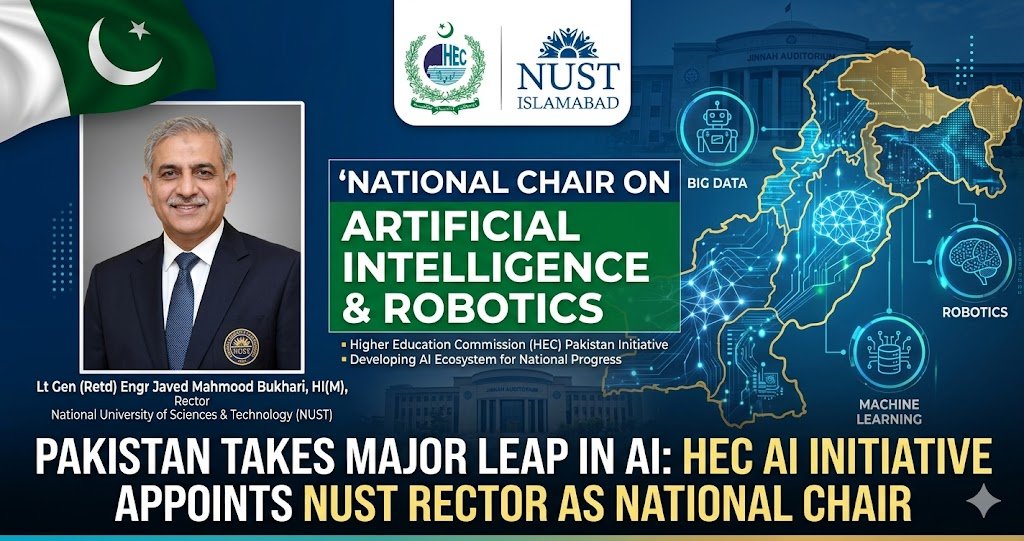
In the development of this landmark, HEC has appointed the Rector of the National University of Sciences and Technology (NUST), Dr. Muhammad Zahid Latif, as the National Chair on an Artificial Intelligence and Robotics. This appointment have highlights the trust and confidence which is placed in NUST as one of the leading institutions of Pakistan in science, technology, and engineering research. The role of the National Chair is not symbolic; as it is highly strategic, with involving a leadership in shaping the national direction for an AI and development of robotics. Based at the NUST Islamabad campus, the chair will function as a central authority to coordinate the initiatives of a research, policy recommendations, and development of an ecosystem in across a multiple institutions. This have includes aligning a national priorities with an academic output and ensuring that the AI development in Pakistan is structured, measurable, and globally competitive. The appointment have also represents a recognition of the growing role of NUST as a hub of an innovation, where the academic excellence meets a real-world technological application.
Role of National Chair in Artificial Intelligence and Robotics Development
The National Chair on AI and Robotics will serve as a critical platform for the direction of policy, strategic planning, and evaluation of an ecosystem in the emerging technology sector of Pakistan. One of the primary responsibilities will be to assess the current state of an AI and robotics in the country and identify a structural gaps that may be limiting a progress. This have includes evaluating an output of research, institutional capabilities, industry adoption, and technological infrastructure. The chair will also work as closely with an HEC-supported national centers such as the National Centre of Artificial Intelligence (NCAI) and the National Centre of Robotics and Automation (NCRA), with ensuring that their efforts are aligned under a unified national framework. By doing so, the initiative aims to eliminate duplication of efforts, improve efficiency, and create synergy in among a various stakeholders. Additionally, the National Chair will contribute to developing a strategies on long-term that have support an innovation, commercialization of the research, and integration of an AI technologies into the real-world applications in across a multiple sectors of the economy.
Collaboration Between Academia, Government, and Industry
A key objective of this initiative is to strengthen a collaboration in between the academia, institutions of government, and the private sector. In a modern ecosystems of innovation, no single entity can drive a technological transformation as alone. Universities have provide a research and talent, governments provide the policy and funding support, while industries have provide a real-world applications and opportunities of a commercialization. The initiative of a National Chair is designed to bridge these gaps and create a coordinated ecosystem where all the stakeholders have work as together toward a shared national vision. In Pakistan’s context, this collaboration is particularly important because an AI and robotics have require a interdisciplinary expertise, investment in infrastructure, and stability of a policy on long-term. By encouraging a partnerships in between the universities like as NUST, government bodies such as the HEC, and private companies of technology, the initiative have aims to accelerate a cycles of an innovation and ensure that the outputs of research translate into a practical solutions that have benefit the society and the economy.
Strengthening Pakistan’s AI and Robotics Ecosystem
Pakistan’s AI and robotics ecosystem is still in its developmental stage, but it have holds a significant potential due to its large youth population, growing industry of tech, and expanding an academic research base. The National Chair initiative is expected to play a central role in strengthening this ecosystem by identifying a weaknesses and proposing the structured solutions. These may include improving a mechanisms of research funding, enhancing the design of a curriculum in universities, and promoting an industry-relevant skill development programs. Furthermore, the initiative have aims to support the development of startup ecosystems which is focused on an AI-based solutions, with encouraging the entrepreneurship in an areas such as the machine learning, automation, data science, and intelligent systems. By creating a more structured ecosystem, Pakistan can position itself as a competitive player in the global AI economy, attracting the investment, fostering an innovation, and producing a high-quality technological talent that is capable of addressing both a national and international challenges.
Role of National Centres (NCAI & NCRA) in AI Advancement
Two major institutions, the National Centre of Artificial Intelligence (NCAI) and the National Centre of Robotics and Automation (NCRA), will play a crucial role in supporting the objectives of the National Chair initiative. These centers are already engaged in an advanced research and activities of a development in their respective domains. Under the new framework, their work will be further integrated and aligned with a national strategic goals. NCAI have focuses on developing an algorithms of AI, models of a machine learning, and intelligent systems, while NCRA have concentrates on a robotics engineering, technologies of an automation, and industrial applications. By connecting these centers under a unified policy structure, Pakistan have aims to enhance a coordination, reduce the redundancy, and improve the impact of an outcomes of research. This integrated approach will also help in benchmarking the progress of Pakistan against an international standards and ensure that a local innovations are aligned with the global technological trends.
Strategic Vision for Pakistan’s Digital Future
The establishment of the National Chair on an AI and Robotics have reflects a broader strategic vision for the digital transformation of Pakistan. In the coming years, AI is expected to play a critical role in shaping the economies, from a healthcare and education to agriculture, manufacturing, and governance. Pakistan’s ability to adapt to this transformation will determine its competitiveness in the global digital economy. The initiative have aims to create a roadmap on long-term that have supports an innovation-driven growth, encourages the investment in an emerging technologies, and builds a knowledge-based economy. This vision have also includes the development of a digital infrastructure, frameworks of an improved data governance, and the integration of AI systems into the public service delivery. By focusing on these areas, Pakistan can move as toward a future where technology is not only a support system but a central driver of an economic and social development.
Objectives of the National AI Chair Initiative
The core objectives of the National Chair initiative have include promoting an excellence of research, developing the national AI policies, and ensuring a strategic alignment in across the institutions. One of the primary goals is to identify the gaps in a current AI and robotics landscape of Pakistan and propose an actionable solutions to address them. This have includes improving a mechanisms of funding, enhancing an academic-industry collaboration, and promoting an innovation-driven education. Another important objective is to develop an international partnerships and benchmark Pakistan’s AI progress against the leading global economies. By learning from an international best practices, Pakistan can adopt a more effective strategies for the research development, talent cultivation, and technology deployment. The initiative have also aims to support a capacity building by training the next generation of an AI professionals and researchers who can contribute to a national development.
Policy Development and Strategic Alignment
Policy development is a critical aspect of the National Chair’s responsibilities. In the absence of a unified AI policy, different institutions have often work in an isolation, leading to an inefficiencies and duplication of an efforts. The initiative have aims to address this challenge by creating a cohesive national framework that have aligns all the AI-related activities under a common strategic vision. This have includes setting a priorities of research, defining an ethical guidelines for the usage of AI, and establishing a structures of governance for the deployment of technology. Strategic alignment have also ensures that an academic research is connected to a needs of industry, with allowing for a smoother commercialization of an innovations. By creating a strong foundation of policy, Pakistan can ensure a sustainable growth in its AI sector while maintaining an ethical standards and global compliance.
International Benchmarking in AI and Robotics
To remain as competitive, it is essential for the Pakistan to benchmark its AI and robotics development in against the international standards. Countries such as the United States, China, and South Korea have made a significant investments in an AI research and infrastructure, with setting a global benchmarks in innovation. The initiative of a National Chair will focus on analyzing these models and adapting a relevant strategies to the context of Pakistan. This have includes studying a successful AI ecosystems, funding models, and education systems that have contributed to a technological leadership in other countries. By adopting a best practices and avoiding the common pitfalls, Pakistan can accelerate its own development trajectory and position itself as a regional hub for AI and robotics research.
Also Read: Pakistan Education Updates 2026: Matric Exam Rules, Laptop Scheme & Curriculum Reforms
FAQs
What is the purpose of an HEC’s National Chair on AI and Robotics?
It have aims to develop a Pakistan’s AI ecosystem through the research, guidance of policy, and innovation coordination.
Who has been appointed as the National Chair on AI and Robotics?
The Rector of NUST, Dr. Muhammad Zahid Latif, has been appointed for this role.
Which institutions will support this initiative of an AI?
NCAI (National Centre of Artificial Intelligence) and NCRA (National Centre of Robotics and Automation) will support it.
How will this initiative benefit Pakistan?
It will improve an innovation, quality of research, digital transformation, and global competitiveness in the AI and robotics.
Conclusion: A Step Toward a Knowledge-Driven Future
The appointment of the NUST Rector as the National Chair on an Artificial Intelligence and Robotics have represents a transformative step in the journey of Pakistan toward becoming a knowledge-based economy. It have reflects a growing recognition of the importance of an emerging technologies in shaping the future of nations. Through a coordinated efforts in between the academia, government, and industry, this initiative has the potential to significantly accelerate the technological progress of Pakistan. While a challenges have remain in a terms of infrastructure, funding, and development of skill, the strategic direction which is provided by this initiative have offers a strong foundation for a future growth. If implemented as effectively, it can position Pakistan as a competitive player in the global AI landscape and pave the way for a sustainable innovation-driven development.