HOW TO LEARN A LANGUAGE ON YOUR OWN: SIX MONTHS, STEP BY STEP
A phone can hold a two-hundred-day streak and a person who still cannot order a coffee. The two facts sit side by side more often than anyone admits.
The streak is not the problem. Believing the streak is the language is.
QUICK ANSWER
To learn a language on your own, build the day around producing the language, not consuming it. Listen to material you mostly understand, mine useful sentences from it, force yourself to say and write things before you feel ready, and space your reviews across days. Speak from week one, badly, on purpose.
WHAT THIS ARTICLE DOES DIFFERENTLY
Most guides hand you a stack of tools and leave the sequencing to you.
This one follows a single learner across six months. You will see what she did first, where it stalled, what replaced it, and how the parts fitted together once they were in the right order.
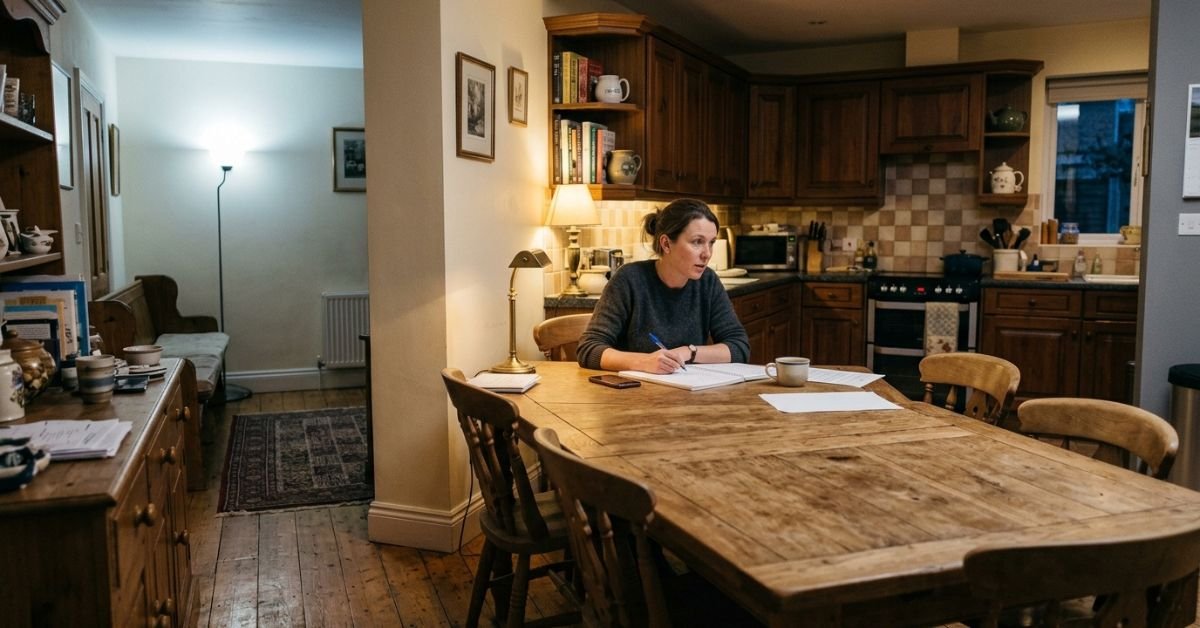
One clarification before we start: Lena is an illustration, not a real reported case. She is a composite built to demonstrate a sequence — an adult in her thirties, full-time job, roughly forty minutes on weekday evenings and one longer stretch at the weekend. Her target language stays unnamed on purpose, because the method does not depend on which one you pick. Her constraints are deliberately ordinary. A routine that only works for people with empty calendars is not worth describing.
MONTH ONE: A PERFECT ROUTINE THAT MEASURED NOTHING
Lena’s first month was disciplined, consistent, and almost entirely wasted.
She downloaded an app, set a nightly reminder, and never missed a session. She added a vocabulary deck of the thousand most common words and worked through it dutifully. On paper it was a model self-study language learning routine.
Three problems were hiding inside it.
Her sessions measured attendance rather than ability — a finished lesson counted the same whether she had understood it or tapped through on autopilot. Her vocabulary arrived as a list, stripped of the sentences that would have shown her how the words behave. And she was building an enormous store of material she could recognise on a screen but had never once produced out loud.
What this phase shows: a routine you can complete without thinking will eventually be completed without thinking. Build the day around an output you can point at instead. “Twenty minutes of app practice” becomes “write four sentences about my afternoon and say them aloud.” The second version can fail. The first can only be attended.
MONTHS TWO AND THREE: THE COMPREHENSION TRAP
Lena’s understanding improved steadily while her speaking stayed at zero, and she mistook the first for progress on the second.
This is the most common failure in independent learning, and it is genuinely deceptive. Following a conversation feels like competence. The words arrive, your brain matches them to meanings it already holds, and the whole thing runs smoothly enough to feel like fluency approaching.
It is not fluency approaching. It is recognition — the ability to confirm meaning when someone else supplies the words. Real conversation asks for something different and much harder: pulling the right word out of an empty head, in the right form, fast enough that the other person does not drift away.
Lena discovered the gap at a family dinner in month three. She understood most of what was said around the table. When someone turned and asked her a direct question, she produced four words and a long silence, then switched languages out of embarrassment.
What this phase shows: input builds the reservoir; only output builds the pipe. You can pour in as much as you like, and nothing comes out until you install the pipe separately.
The signal to watch: can you describe your last hour out loud, unprepared, without switching languages? If not, you have been understanding a language. You have not yet been using one.
THE REBUILD: OUTPUT FIRST, EVERY SINGLE DAY
Lena inverted her routine — the study material became raw supply, and the session’s real work was making sentences.
The change took one evening to set up and cost her no extra time. Her new forty minutes ran in three parts.
- Produce. Before any input, she wrote five sentences about her own day, then said each one aloud. No dictionary until she had tried. Wrong endings and clumsy word order all stayed on the page.
- Repair. Only then did she look up what she had been unable to say, and only those specific gaps — never a general vocabulary sweep.
- Mine. From that day’s listening or reading, she pulled two or three complete sentences that expressed something she personally wanted to say, and added those to her review deck whole.
Three details turned this from theory into a habit that held.
She saved sentences, not words. A single word teaches you a meaning. A sentence teaches you the meaning, the grammar around it, the word order, and the register — all at once, without a grammar lesson.
She spoke everything aloud. Silent reading of a sentence trains the eyes. The mouth needs its own practice, and the physical act of forming unfamiliar sounds is a skill that improves only through repetition.
She kept a running list of what she could not say. Every failure went into a document. That list, not the app, became the real curriculum, because it pointed exactly at the language her actual life required.
What this phase shows: the fastest route to speaking is speaking badly, early, and often. Every sentence you cannot finish marks the precise spot where your study belongs tomorrow.
INPUT AND SPACING: THE QUIET ENGINE
Lena stopped hunting for difficult material and started living inside material she mostly understood.
Her early instinct had been to reach for news broadcasts and adult novels, on the theory that harder was faster. In practice she spent those sessions decoding rather than absorbing, looking up so much that nothing settled.
The replacement rule was simple. She chose listening and reading where she could follow the thread with occasional gaps — comprehensible input, in other words, pitched just above her current level rather than far beyond it. Children’s programmes, learner podcasts, and eventually ordinary shows with the audio in her target language. Roughly twenty minutes a day, often while cooking or commuting, which cost her no dedicated time at all.
Alongside it, her mined sentences ran on a revisit ladder: the next day, three days later, about a week later, then a month later. Short passes, never long ones.
The counterintuitive part is that a review works best when the memory has begun to fade. Retrieving a sentence you have half-forgotten feels slow and uncomfortable, and it produces a far more durable memory than reviewing something still fresh. The difficulty is the mechanism, not an obstacle to it.
What this phase shows: input and spacing are the parts of learning a language on your own that run in the background. Set them up once and they keep working while you do something else.
MONTHS FIVE AND SIX: REHEARSING THE REAL THING
Lena stopped preparing to speak and started speaking, on a schedule, with consequences.
Studying a language and using one under social pressure are two separate skills, and the second is the only one anyone will ever see. She trained it deliberately.
Her rehearsal rules were short.
- Two live conversations a week, with a real person, unscripted, at a fixed time she could not quietly postpone.
- No English rescue in the first fifteen minutes — she was allowed to be slow, wrong, and repetitive, but not to switch out.
- Every stumble became a note. Whatever she could not say went straight onto her list and into the next day’s sentence practice.
- One recorded monologue a week, two minutes, unprepared, listened back once. Uncomfortable, and the fastest correction tool she had.
She also protected her energy on purpose. Sessions ran short and daily rather than long and occasional, because language is a habit-shaped skill and a marathon weekend does not compensate for five silent days. One day each week stayed genuinely empty — not light practice, empty — and a missed day was logged and forgotten rather than turned into a reason to quit.
What this phase shows: in the second half of the journey, practise the conversation, not the curriculum.
WHAT ACTUALLY TRANSFERRED
Six months in, Lena was not fluent, and that was never the target.
She could hold a slow conversation about her work, her family and her plans. She could ask for help when a sentence collapsed halfway through, in the target language, which is the single most useful skill an intermediate learner owns. She could follow a group conversation for stretches and lose it in others.
Her weekly hours had barely changed since month one. What changed was where those hours landed: on producing language rather than recognising it, on sentences rather than isolated words, on material she could almost follow rather than material that flattened her.
The more useful result was that the routine survived a bad month. When work travel wiped out three weeks, she came back to a list of things she could not say and a deck ready to be reviewed, and rebuilt in days rather than starting over. That is the honest test of a self-study method — not how it performs in an ideal week, but what it leaves you holding after a broken one.
HOW TO LEARN A LANGUAGE ON YOUR OWN: THE WHOLE METHOD ON ONE PAGE
| Stage | What you do | How you know it worked |
|---|---|---|
| Aim | Define a use, not a level (“talk to my partner’s family”) | You can name the situation you are training for |
| Produce | Write and say your own sentences before any study | You attempted before you looked anything up |
| Repair | Look up only what you failed to say | Your gap list grows on purpose |
| Mine | Save whole sentences you personally want to use | Reviews feel relevant, not random |
| Input | Daily listening you mostly understand | You follow the thread without constant pausing |
| Space | Review at day 1, day 3, week 1, month 1 | Recall gets faster across passes |
| Rehearse | Two unscripted live conversations weekly | You recover from mistakes instead of switching languages |
FIVE MISTAKES THAT QUIETLY CANCEL OUT REAL EFFORT
Each of these feels like study and behaves like waiting.
- Waiting until you are “ready” to speak. There is no threshold. The readiness is manufactured by speaking, which means the wait is permanent.
- Collecting words instead of sentences. A long vocabulary list with no structures attached produces a learner who knows many words and can build nothing.
- Choosing material far above your level. Constant lookups turn absorption into translation, and translation is a slower, separate skill.
- Studying grammar as a subject in itself. Rules explain patterns you have already met. Encountered first, they are theory; encountered second, they are clarification.
- Treating a missed week as a verdict. The people who succeed are not the ones who never stop. They are the ones who restart quickly and without drama.
KEY TAKEAWAYS
- Understanding is not speaking — input fills the reservoir, output builds the pipe, and they must be trained separately.
- Produce first in every session, then repair only the gaps your own sentences exposed.
- Save whole sentences, never bare word lists, so grammar arrives attached to meaning.
- Choose comprehensible input slightly above your level; harder is not faster.
- Space your reviews across days and let the difficulty do the work.
- Speak with a real person on a fixed schedule from early on, and define your goal as a situation rather than a level.
WHAT TO WATCH NEXT IN YOUR OWN LEARNING
Give this eight weeks, then check four signals instead of your mood.
Watch whether your gap list is being cleared, not just extended — a list that only grows means you are producing but never repairing. Watch whether recovery is getting faster: the moment a sentence collapses, do you rephrase and continue, or stop? That single behaviour separates learners who progress from learners who plateau politely.
Watch your listening comfort, separately from your speaking, because comprehension almost always moves first and it is easy to mistake its improvement for overall progress. And watch whether the routine survives a disrupted week; if one bad week ends it, the daily unit is too large and should shrink until it is impossible to skip.
People also ask how long it takes to learn a language, and the honest answer is that it depends on the distance between the language and the ones you already speak, on how much of your day the language can realistically occupy, and on how early you start producing it. A usable conversational level in months is realistic for many learners. Anything promising fluency on a fixed timetable is selling certainty that does not exist. For formal levels, certificates or exam requirements, check the official framework or examining body that applies where you live, since those standards differ from country to country.
FAQ
Q1. Can you really learn a language without a teacher?
Yes, to a conversational level, provided you replace what a teacher supplies: correction, structure and obligation. Correction can come from a language partner or from recording yourself. Structure comes from a fixed daily unit. Obligation comes from scheduled conversations you cannot silently cancel.
Q2. How much time per day is actually enough?
Thirty to forty focused minutes daily beats three long weekend sessions, because language is habit-shaped and consolidates between sessions. If forty is unrealistic, take fifteen and keep it unbroken. A small unit you never miss outperforms a large one you abandon in week five.