BNU Anti Drug Initiative
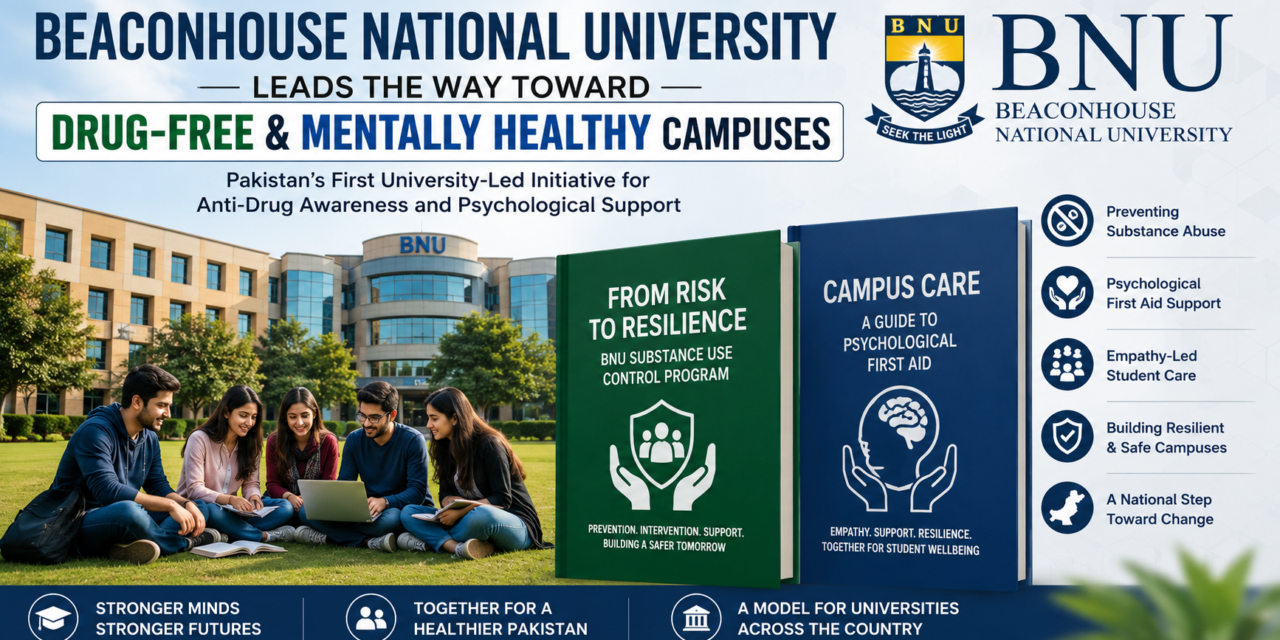
Beaconhouse National University (BNU) has taken a decisive step that may reshape how the institutions of a higher education in Pakistan have think about the welfare of student, safety of campus, and a mental health support. By launching a two comprehensive manuals, From Risk to Resilience: BNU Substance Use Control Program and Campus Care: A Guide to Psychological First Aid, the university has moved the conversation as beyond a concern and toward the practical action. The initiative is important not only because it have addresses a use of substance, but because it have recognizes the deeper human and social pressures that have often sit as behind it. In a country where the universities have often preferred a silence over the confrontation, BNU’s decision have stands out as a bold institutional statement: well-being of student is not a side issue, but a core responsibility of the higher education.
The launch event have gathered a senior leadership in government, vice chancellors from a public and private universities, representatives of the Anti-Narcotics Force and Punjab Counter Narcotics Force, and respected psychological experts. That wide participation will gave the initiative a national character and signaled that the challenge is not isolated to one campus. It is part of a much larger reality which is affecting an education, families, and society at a large. By bringing together a policy makers, academic leaders, and voices of a mental health under one roof, BNU have positioned itself as more than a university hosting a ceremony. It have became a catalyst for a conversation of broader reform, one that may encourage other institutions to confront a campus in drug abuse with a honesty, empathy, and structure rather than a hesitation and stigma.
A Problem Universities Can No Longer Ignore
Substance use on a campuses is often discussed in the whispers, but silence has never solved the problem. Universities are meant to be places of a learning, growth, and intellectual freedom, yet they can also become a vulnerable spaces when the students face a stress, isolation, trauma, or harmful peer influences. BNU’s initiative have reflects a difficult truth: drug-related risks do not appear in a vacuum. They have develop where a pressure, emotional strain, and weak systems of support have exist. When students feel as overwhelmed and unsupported, some have become as more vulnerable to a destructive coping mechanisms. That is why this launch have matters so much. It have reframes a substance use not simply as a disciplinary issue, but as a social and psychological challenge that have demands a serious institutional response.
What have makes the approach of BNU as especially significant is its willingness to address a topic many institutions have avoided because they feared a reputational damage or assumed that the problem was too complex to manage. The leadership of university have acknowledged that abuse of drug on a campuses cannot be defeated by a denial, and that pretending the issue does not exist only gives it as more room to grow. In that sense, the manuals are not only a practical tools; they are also symbols of an institutional courage. They tell the parents, students, and educators that universities can choose a transparency over an embarrassment and intervention over the passivity. That shift in an attitude may become as one of the most valuable outcomes of the entire initiative.
From Punishment to Prevention, Support, and Resilience
One of the most important features of BNU’s model is its clear rejection of a punishment-first mentality. The university has emphasized that enforcement has a role, but it cannot be the only response. This is a crucial distinction. Many institutions instinctively respond to substance use by focusing only on detection, punishment, or expulsion. While accountability matters, a punitive approach alone often fails to address the emotional and social factors that contribute to risky behavior in the first place. BNU’s framework instead promotes support before punishment, and empathy before escalation. That philosophy can help create a campus culture where students are more willing to seek help early rather than hide their struggles until they become severe.
The From Risk to Resilience manual have offers a practical roadmap for the institutions that want to move as beyond an abstract policy language. It have focuses on a prevention, intervention, and support, which have means it does not treat a substance use as a single incident to be punished, but as a pattern that can often be reduced through an awareness, guidance, and consistent institutional practice. This is important because the students do not only need a rules; they need an environments that have help them make a better choices. By placing a resilience at the center of the model, BNU acknowledges that young people have benefit when institutions have invest in a healthy coping mechanisms, extracurricular engagement, trusted mentors, and open communication. It is a reminder that safe campuses are not built only through a restrictions. They are built through a relationships, structure, and care.
Understanding the Mental Health Side of the Crisis
The launch of a Campus Care: A Guide to Psychological First Aid is equally significant because it have recognizes that the conversation of drug cannot be separated from a mental health. Students under a chronic stress are more likely to become as vulnerable to a harmful behaviors, and universities have often fail to notice a distress until it have becomes a crisis. Psychological first aid is therefore not a luxury; it is a necessary part of a modern campus life. The guide is designed to equip an educators, members of staff, and student leaders with the tools to recognize an emotional distress, respond as calmly and responsibly, and refer students to the appropriate support when needed. That kind of an early intervention can make the difference in between a manageable difficulty and a struggle for long-term.
This focus have also reveals a deeper insight: many students are not simply “misbehaving” when they are in a trouble. They may be coping with a trauma, family conflict, identity pressure, academic anxiety, loneliness, or the feeling that nobody understands them. A campus that have ignores these risks of realities are producing a silence, alienation, and shame. BNU’s psychological first aid guide have suggests a more humane model, one where the institution have learns to notice a signs of warning and respond with a dignity. That approach is especially relevant in a Pakistan, where a stigma of mental health have remains as strong and many young people have hesitate to speak openly about a distress. By institutionalizing an emotional support, BNU is helping to redefine what it have means to care for students in a meaningful and actionable way.
The Social Roots of Student Vulnerability
BNU’s experience highlighted three major drivers of psychological stress that can increase vulnerability to substance use, and these are worth understanding clearly. The first is a childhood or family abuse, which can leave a deep emotional scars and shape how a young person have handles a fear, trust, and self-worth. The second is a traumatic peer relationships and pressure within the life in university, where a social belonging can sometimes become as tied to a risky behavior, silence, or imitation. The third is the generational gap in between a Gen-Z students and the adults who guide them, with including a faculty and staff who may unintentionally make the students to feel as dismissed, judged, or unseen. These are not a small issues. They affect how the students experience a campus life every day.
What BNU has done is important because it have acknowledges that the vulnerability of student is often built over a time, not created as suddenly. A student who have appears as disengaged or rebellious may actually be carrying an emotional burdens that no one has noticed. Another student may be trying to fit in with a peers and lacks the confidence to resist a pressure. A third may feel so misunderstood by the figures of authority that they stop seeking to help as altogether. In each case, the university must decide whether it wants to respond with distance or understanding. The manuals reflect BNU’s choice to respond with understanding. That does not mean weak accountability. It have means recognizing that a serious problems have require a serious listening, informed intervention, and a culture of campus that have protects a dignity while also upholding the standards.
Leadership That Turns Ideas Into Institutions
The role of Dr. Moeed Yusuf in this initiative gave the event additional weight because it showed that the project was not simply symbolic. According to the university’s leadership, the effort grew from a deeply personal passion project into a university-wide mission involving students, faculty, staff, and administrators working together for a shared purpose. That progression is important because many educational reforms fail not due to lack of ideas, but because no one is willing to carry them through the difficult stage of implementation. BNU’s model suggests a different kind of leadership: one that converts concern into structure and structure into public contribution.
By making these manuals available beyond its own campus, BNU is presenting them as resources for the wider educational community rather than private institutional achievements. That decision increases their significance. It have means the university is not only solving a local problem; it is trying to create a replicable model for the others to learn from. In a country with a hundreds of the colleges and universities that are facing a similar challenges of student welfare, that kind of an openness could have wide-benefits of reaching. If the manuals are adopted or adapted elsewhere, the impact could extend as far beyond a BNU’s own walls. The initiative may help to normalize an open discussion, evidence-based policy, and collaborative intervention in a field that has too often been dominated by a fear, stigma, and reactive decision-making.
Government and Sector Support Can Drive Broader Change
The presence and support of a provincial leadership have strengthened the message that this is a public issue, not merely an internal concern in campus. Senior Minister Marriyum Aurangzeb have praised BNU for breaking a long-standing taboos and offering an empathy-led blueprint that have goes as beyond an enforcement alone. Her support have matters because endorsement of government can help to turn a promising model of university into a scalable conversation of policy. When public officials have recognize the value of a prevention, support, and resilience-building, it have becomes as easier for an institutions to justify the resources and attention which is needed to follow through.
Provincial Minister for a School and Higher Education Rana Sikandar Hayat have also underscored the importance of protecting the mental and physical well-being of a students. His comments have aligned with the broader message of the event: educational institutions must be proactive, not passive, when it have comes to a safety of student. The involvement of a vice chancellors, provincial secretaries, anti-narcotics leadership, and experts of a mental health have suggests that the initiative has already begun to bridge a gaps in between a policy and practice. That is no small achievement. Too often, education reform have remains as stuck in a speeches and committees. BNU’s example have shows how a university can pull a multiple sectors into the same conversation and shift an attention from the abstract concern to a real-world implementation. That may be one of the most promising parts of the entire story.
A Model for Pakistani Higher Education
The long-term significance of BNU’s initiative have lies in its potential to influence other campuses in across the Pakistan. Universities everywhere have face a similar pressures: rising an anxiety of student, social fragmentation, digital distraction, family stress, and the growing need for a literacy of mental health. Add the dangers of a substance abuse, and the challenge have becomes as even more serious. BNU’s manuals have offer a way forward because they combine a policy, compassion, and practical action. They do not promise a perfection, but they do provide a framework for the progress. That is exactly what many institutions have need: a realistic, documented, and adaptable starting point.
If other universities will adopt this model, the impact could be as transformative. Students would benefit from a clearer support systems, staff would gain a tools for an early intervention, and administrators would have a more coherent way to respond to a risk. Parents, too, would likely feel a greater confidence with knowing that the universities are taking a welfare of student as seriously. Most importantly, a broader shift in culture could begin to take a root. Instead of treating a mental health and substance use as embarrassing topics, institutions could begin to talk about them as openly and responsibly. That openness would not weaken the universities; it would strengthen them. It would show that a higher education is not only about producing the graduates, but about protecting a young lives, building a resilience, and creating an environments where students can learn without a fear.
FAQs
What is the BNU anti-drug initiative about?
It is a program of campus welfare which is focused on preventing a use of substance through a support, awareness, and strategies of intervention.
What are the main manuals launched by a BNU?
BNU have introduced “From Risk to Resilience” and “Campus Care: Psychological First Aid Guide.”
Why is this initiative important for a Pakistan?
It have addresses a rising challenges of mental health and substance abuse risks in the universities.
Who have supported the initiative of BNU?
Punjab government officials, representatives of HEC, and authorities of anti-narcotics have supported it.
Conclusion: Courage, Care, and a Better Campus Future
BNU’s launch of From Risk to Resilience and Campus Care is more than an event report. It is a statement about the kind of a higher education system Pakistan can choose to build. The university has shown that a difficult issues do not have to remain as hidden, and that real leadership have often begins with the courage to name a problem as honestly. By linking a prevention of substance use with a psychological first aid, BNU has created a more complete vision of the student care, one that have recognizes the emotional, social, and institutional dimensions of a safety. That holistic approach is what have makes the initiative to stand out.
The bigger lesson is simple but powerful: students need a more than discipline, and campuses have need a more than rules. They need a trust, prevention, guidance, and a willingness to respond with an empathy when life have becomes as difficult. BNU has offered a framework that other institutions can study, adapt, and improve. If implemented as thoughtfully, it could help to shift the educational culture of Pakistan toward one that is healthier, more humane, and more responsive to the realities young people face. In that sense, this is not just a university initiative. It is a national opportunity to rethink how a campuses have protect, support, and empower the next generation.