Pakistan Education Update 2026 – Latest Overview
The education system of Pakistan is going through one of its most significant phases of transformation in 2026, which is driven by a digitalization, curriculum modernization, and student-centered reforms that are introduced by a federal and provincial authorities. The latest announcements from the Ministry of Federal Education and Professional Training (MoFEPT), Higher Education Commission (HEC), and departments of a provincial education have highlight a structured effort to modernize both the school and university-level education. These updates have include a confirmed schedules of summer vacation, a nationwide shift toward the digital degree attestation, and the introduction of an artificial intelligence (AI) as a compulsory academic subject in the institutions of higher education.
In an addition to the administrative reforms, Pakistan’s education authorities are focusing on improving an accessibility and inclusivity in the education. Programs that are targeting out-of-school children, especially in an urban centers like as Islamabad Capital Territory (ICT), are being expanded through the evening school shifts. These initiatives have aim to reduce a rates of dropout and provide an opportunities of flexible learning for a students who are unable to attend the traditional daytime classes. Alongside this, job opportunities in a specialized institutions of education such as the Centre of Excellence for Autism have further demonstrate the emphasis of government on an inclusive policies of education.
Overall, 2026 have marks a shift toward a more digital, structured, and skill-oriented system of education in Pakistan, where an integration of technology, policy standardization, and academic modernization are the central priorities. This transformation is expected to impact a millions of the students in across schools, colleges, and universities, which is making it as one of the most important reform of education phases in a recent years.
Summer Vacations Announcement in Punjab and Balochistan 2026
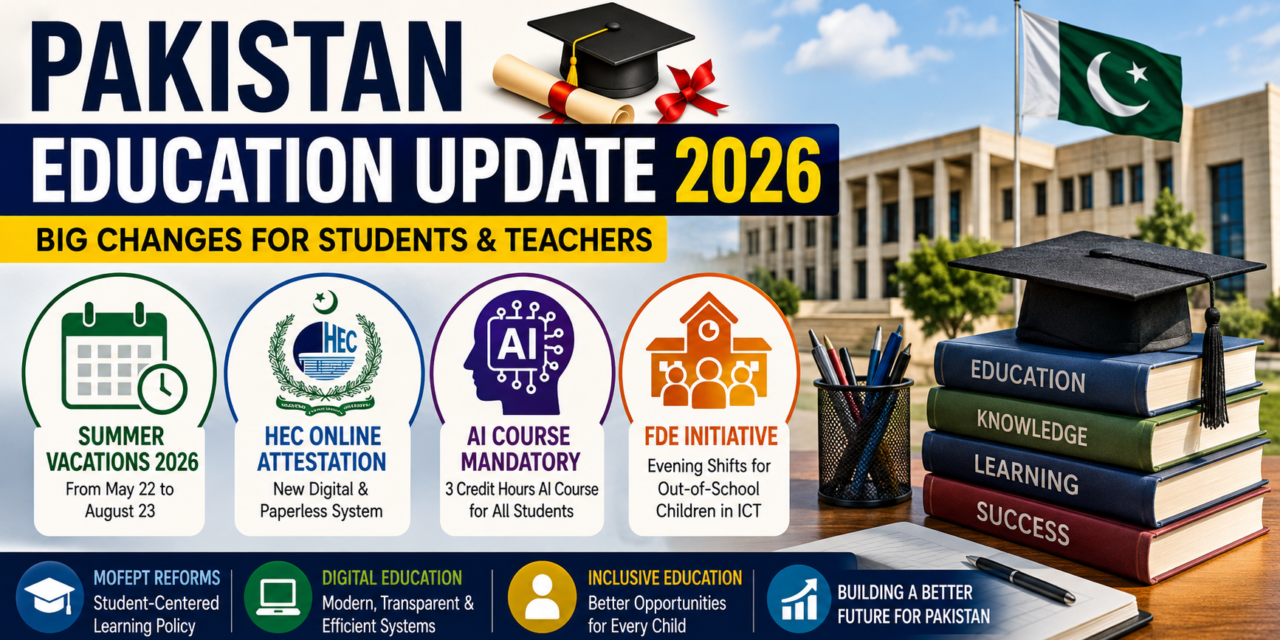
One of the most widely discussed updates in the education system of Pakistan for 2026 is the official announcement of a summer vacations in the Punjab and Balochistan. According to the latest notification, schools in both a provinces, covering the public and private institutions, will remain as closed from a May 22, 2026, to August 23, 2026. This long break of summer has been implemented due to an extreme conditions of weather and rising temperatures in during a months of peak summer, which have make it as difficult for a students to continue a regular academic activities as safely.
The decision has been generally welcomed by a parents and students, although some associations of a private school have expressed a concerns that are regarding to the lengthy period of closure. They have argue that an extended vacations may affect the academic calendar and delay a completion of syllabus. However, provincial education authorities have maintained that the health and safety of student have remain the top priority. To balance an academic disruption, schools are expected to adjust their annual schedules, possibly by extending a hours of study before or after the period of vacation.
This schedule of a summer vacation have also reflects a broader pattern in the education policy of Pakistan where a conditions of climate are increasingly being considered in an academic planning. In a recent years, heatwaves and environmental changes have forced the departments of education to revise a traditional academic calendars. As a result, schedules of an adaptive learning are becoming as more common, with ensuring that the wellbeing of students is not compromised while maintaining an educational continuity.
Higher Education Commission (HEC) New Digital Attestation System
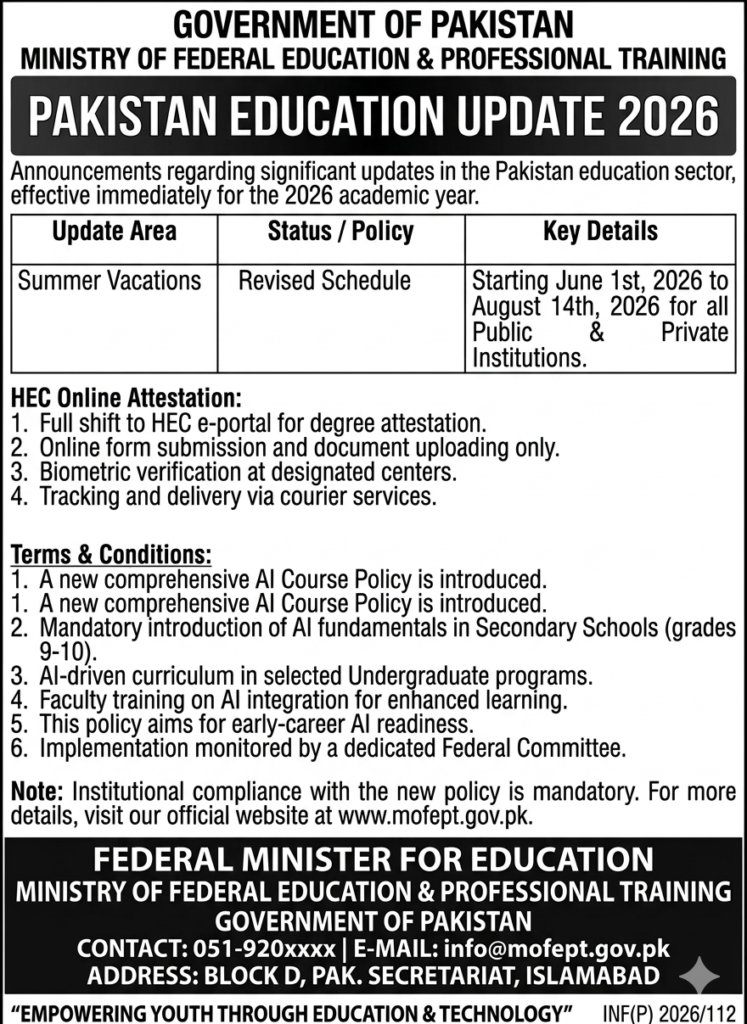
Another major reform which is introduced in 2026 is the launch of a fully online and paperless degree attestation system by the Higher Education Commission (HEC) of Pakistan. This initiative is part of a larger digital transformation strategy which is aimed at eliminating a manual paperwork and reducing the delays in processing for students and graduates. The new system have allows an individuals to submit their verification of a degree and requests of attestation as entirely online without physically visiting the offices of HEC .
Through this digital platform, users can upload an academic documents, track the status of application, and receive a certificates of verified attestation electronically. This have not only saves a time and costs of travel but also increases a transparency and reduces the risk of a fraud in document . The HEC has also integrated a technologies of secure verification to ensure an authenticity and protect the academic records from a manipulation.
For students who are applying for a jobs in abroad or opportunities in a higher education, this system is expected to significantly simplify the process of verification. Previously, degree attestation in Pakistan have involved a long queues, manual verification, and extended periods of waiting. Now, with the digital system in a place, time of processing is expected to be reduced substantially, and improving an efficiency for the thousands of an applicants each month.
This move is also aligned with a global trends in the digital governance and e-administration, where a governments are shifting toward the paperless systems to improve a delivery of service and reduce the operational inefficiencies.
MoFEPT Education Reforms and Student-Centered Learning Policy
The Ministry of Federal Education and Professional Training (MoFEPT) has introduced a new reforms in 2026 which is focused on shifting the education system of Pakistan toward a student-centered model of learning . This approach have emphasizes a critical thinking, problem-solving skills, and practical knowledge rather than a methods of traditional rote memorization. The goal is to prepare the students for a demands of modern workforce and global competition.
Under these reforms, curriculum development is being redesigned to incorporate methods of interactive learning, project-based assessments, and skill-oriented modules of education. Teachers are also being trained to adopt a modern methodologies of teaching that have encourage the participation of student and creativity in a classrooms.
The student-centered approach have also focuses onan inclusivity, with ensuring that learners from a diverse backgrounds have receive an equal educational opportunities. Special attention is being given to a development in rural education, teacher training programs, and improvement of infrastructure in an underdeveloped regions.
These reforms have represent a significant shift from the conventional practices of education in Pakistan and are expected to gradually transform that how the students learn, interact, and develop an academic skills in across all the levels of education.
New AI Course Requirement for Universities in Pakistan
One of the most advanced policy changes in 2026 is the mandatory introduction of a 3-credit hour Artificial Intelligence (AI) course in all the undergraduate and postgraduate programs under a regulations of HEC. This decision have highlights the commitment of Pakistan to integrating a modern technology education into its academic system and preparing the students for a future job markets.
The AI course is designed to introduce a students to fundamental concepts such as machine learning, data analysis, automation, and intelligent systems. Regardless of their major field, science, commerce, arts, or engineering, all the students will be required to complete this course as part of their degree program.
This initiative is expected to significantly enhance a digital literacy in among the graduates and improve their employability in a global tech-driven industries. With AI is becoming a core component of the modern economies, this policy have aims to bridge the skill gap in between the Pakistan and developed countries in the field of an emerging technologies.
Universities are currently working on an integration of curriculum and training of faculty to ensure a smooth implementation of this requirement. Over time, this policy is expected to reshape a higher education in the Pakistan by making a technology education as a standard part of an academic learning.
FDE Initiative for Out-of-School Children in ICT Schools
The Federal Directorate of Education (FDE) has introduced a significant initiative in 2026 which is aimed at addressing one of the most pressing educational challenges in Pakistan: the growing number of out-of-school children. To tackle this issue, the government has launched an evening shifts in the selected schools within the Islamabad Capital Territory (ICT), with allowing the students who are unable to attend a regular classes in morning to continue their education in the evening session.
This initiative is designed to provide an opportunities of flexible learning for children from the low-income families, working students, and those who face a transportation or issues of accessibility in during a standard school hours. By introducing a dual shifts, the FDE have aims to maximize the use of an existing educational infrastructure while ensuring that more children can be brought into the system of formal education.
The evening shift program have also reflects a broader shift in policy toward an inclusive education in Pakistan. In an addition to the academic instruction, these programs may include a support of basic literacy, remedial learning, and skill-based training which is depending on the needs of student. Education authorities have believe that such a flexible systems can significantly reduce the rates of dropout and help to bridge the education gap in an urban and semi-urban areas.
Over time, if successful, this model may be expanded to other cities and provinces, which is making it a nationwide strategy to combat an educational inequality.
Centre of Excellence for Autism Job Opportunity 2026
Alongside a policy reforms, the sector of education in Pakistan is also creating a new opportunities of employment, particularly in a specialized institutions. One notable announcement is the vacancy of job at the Centre of Excellence for Autism, which is open until May 25, 2026. This position have reflects the growing focus of government on an inclusive education and support for children with the special needs.
The Centre of Excellence for Autism is responsible for providing a specialized education, therapy, and support services to children on the spectrum of autism. The available opportunities of job are designed for a professionals who have an experience in the special education, psychology, therapy, and development of child.
This initiative is important because it have highlights the increasing recognition of Pakistan of the need for a structured support systems for children with a developmental challenges. By investing in a trained professionals and specialized institutions, the education system is gradually becoming as more inclusive and diversified.
Such an opportunities have also open a pathways of career for the educators and professionals of healthcare who want to contribute to a special education services in Pakistan. This have aligns with a global standards where an inclusive education is considered a fundamental right for all the children.
Impact of New Education Policies on Students and Teachers
The combined impact of these education reforms in 2026 is expected to be significant for both a students and teachers in across the Pakistan. For students, the introduction of a digital systems, revised academic structures, and AI-based learning have represents a shift toward a more modern and skill-oriented environment of education. Students will benefit from an improved access to the services, better tools for learning, and an updated curricula that have align with a global education standards.
For the teachers, however, these reforms will require an adaptation and training. The shift from a methods of traditional teaching to student-centered learning and technology-integrated classrooms have means that the educators will need to upgrade their skills. While this may initially create a challenges, it will ultimately lead to an improved quality of teaching and better engagement in classroom.
Additionally, administrative changes such as an online attestation and digital record systems will reduce a paperwork and bureaucratic delays, with allowing the institutions to operate as more efficiently. Overall, these reforms have aim to create a balanced ecosystem where both the students and educators have benefit from a modernization.
Future of Education System in Pakistan 2026 and Beyond
The education reforms that are introduced in 2026 have represent the beginning of a long-term transformation in the academic landscape of Pakistan. With an increasing emphasis on the digitalization, artificial intelligence, and student-centered learning, the future of education in Pakistan is expected to become as more technology-driven and globally competitive.
In the coming years, further integration of an online learning platforms, digital classrooms, and AI-based assessment systems is likely. These advancements will not only improve an access to the education but also enhance an outcomes of learning by making the education as more interactive and personalized.
Moreover, the focus on an inclusivity and accessibility have suggests that Pakistan is moving toward an education system that have caters to a diverse needs of student, which is including those in a rural areas, underprivileged communities, and special education sectors. If these reforms are implemented as effectively, they have the potential to significantly improve a rates of literacy and overall educational quality in the country.
FAQs
When will the summer vacations start in Pakistan in 2026?
Summer vacations in the Punjab and Balochistan are scheduled from a May 22 to August 23, 2026, which is according to the latest notification of education.
What is the new online attestation system of HEC?
HEC has launched a fully digital system that have allows the students to apply for an attestation in degree online without visiting the offices as physically.
Is AI course mandatory in universities of Pakistan?
Yes, HEC has made a 3-credit hour AI course which is mandatory for all the undergraduate and postgraduate programs.
What is the FDE evening shift program?
FDE has introduced an evening shifts in the ICT schools to provide an education opportunities for out-of-school children and working students.
Conclusion
The Pakistan education system update 2026 have marks a major turning point in the academic development of country. From a confirmed summer vacations in the Punjab and Balochistan to the introduction of a digital attestation system of HEC and mandatory AI courses in the universities, these reforms have reflect a strong push toward the modernization and digital transformation.
At the same time, initiatives like as FDE evening shifts and special education job opportunities have highlight a growing commitment to an inclusivity and accessibility. While a challenges such as the gaps of an implementation and adaptation to a new systems have remain, the overall direction of these reforms is clearly focused on improving a quality, efficiency, and global competitiveness.
In the coming years, Pakistan’s education system is expected to evolve as further into a more structured, technology-integrated, and student-friendly model.