Pakistan Education Updates 2026 Overview
Pakistan’s education system is undergoing a significant transformation in the 2026, with a major reforms that are introduced by the Higher Education Commission (HEC), provincial education boards, and school authorities. These updates are aimed at modernizing an academic structures, with improving the digital literacy, and aligning the education system of Pakistan with a global technological standards. One of the biggest highlights is the introduction of an Artificial Intelligence (AI) courses as a mandatory part of university degree programs that are starting from 2026. Alongside this, multiple changes in an intermediate examinations, board fee structures, and school-level policies have been announced, especially in the Punjab and Sindh. These developments are being widely reported and discussed in across the platforms of education, which is making them as highly relevant for a students, parents, and academic professionals.
The reforms of education are not limited to a higher education only; as they also include a school-level regulations such as restrictions on selling the books and uniforms, initiatives of a digital learning, and policy discussions which is regarding to the school holidays. In Karachi, intermediate examinations have already started, which is creating an urgency in among the students who are preparing for board exams. Meanwhile, Punjab education boards have increased a fees of registration and migration, which is raising a concerns in among the parents about an affordability. These updates have collectively reflect the ongoing efforts of Pakistan to modernize education while addressing a long-standing structural challenges.
HEC’s New Policy – AI Courses Mandatory by 2026
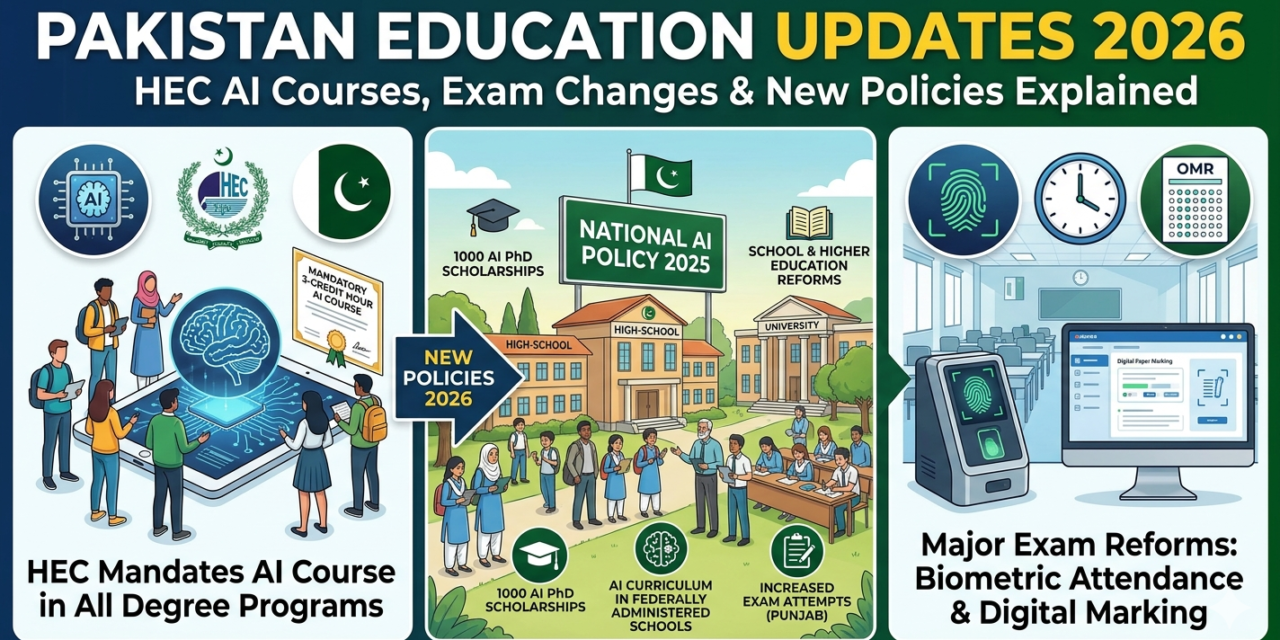
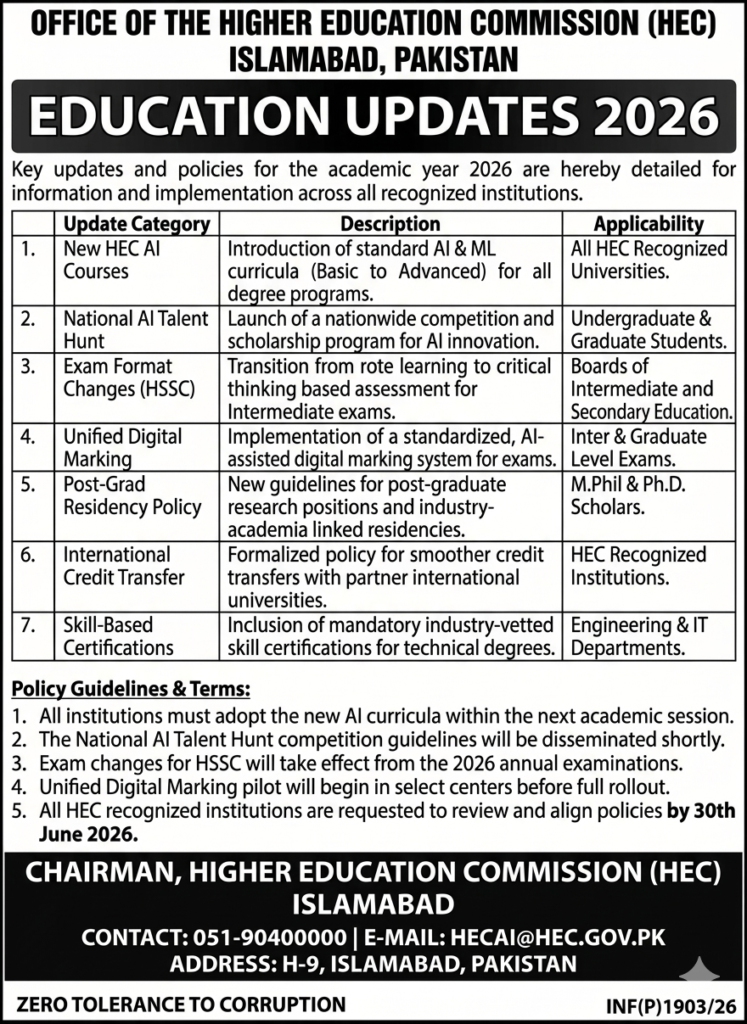
The Higher Education Commission (HEC) of Pakistan has introduced a groundbreaking policy that will make an Artificial Intelligence (AI) courses as mandatory for all the university degree programs which is starting from 2026. This decision is part of a broader strategy to equip the students with a future-ready digital skills that have align with a demands of global job market. According to the framework of policy, students who are enrolled in the engineering, business, social sciences, and even arts programs will be required to complete a basic AI and digital literacy modules as part of their academic curriculum. The move is expected to revolutionize a higher education in the Pakistan by bridging the gap in between a traditional education and modern technological advancements.
This policy is particularly significant because AI is rapidly becoming a core component of an industries such as the healthcare, finance, education, and software development. By integrating an AI education at the university level, HEC have aims to produce a graduates who are not only academically qualified but also technically skilled. However, this transition have also presents a challenges, which si including the need for a trained faculty, updated design of curriculum, and access to a digital infrastructure in the universities in across Pakistan. Despite of these challenges, education experts have believe that this step will significantly improve the global competitiveness of Pakistan in the field of technology and innovation.
Intermediate Exams 2026 – Karachi Latest Updates
In Karachi, the annual intermediate examinations for Class 11 and Class 12 have officially commenced, which is marking an important phase in the academic calendar of Pakistan. Thousands of a students are currently participating in the board exams that are conducted under a strict supervision to ensure the fairness and transparency. The schedule of examination has been carefully structured, and students have been advised to follow all the guidelines as issued by the boards of education to avoid any disciplinary action. These exams have play a critical role in determining the future academic and career paths of students, which is making them as one of the most important milestones in the education system.
Authorities have also implemented an enhanced measures of security at examination centers, which is including a systems of surveillance and monitoring the teams to prevent cheating and misconduct. In an addition, distribution of an exam paper has been digitized in some regions to minimize the risks of a leakage. Students have been encouraged to focus on a strategies of preparation and techniques of a time management to perform as well. The start of these exams has also increased an online search interest in topics such as the “inter exams Karachi 2026 schedule” and “Pakistan education updates May 2026,” which is indicating high public engagement with this development.
Punjab Education Updates – Fee Increase & Student Changes
Punjab’s education boards have announced a revision in the fees for a registration of matriculation and migration, which has sparked a widespread discussion in among the students and parents. The increase in fee is part of an administrative restructuring plan which is aimed at improving a board operations and funding the digital transformation projects. However, this decision has also raised a concerns regarding to an affordability, especially for the students from a families of low-income. Education authorities have stated that the revised structure of fee is necessary to support efforts of modernization and maintain an administrative efficiency in across the examination boards.
Alongside a fee changes, Punjab has also introduced programs of an internship for PharmD students, with offering an opportunities of practical training in the institutions of healthcare. These initiatives are designed to enhance an employability and provide the students with a real-world experience. Additionally, digital literacy programs are being implemented in a selected schools to promote the modern techniques of learning. These combined efforts have reflect the focus of Punjab on improving both an academic quality and practical skill development for students.
New School Policies in Pakistan (2026)
Pakistan’s education authorities have introduced a several new school-level policies in 2026 that are aimed at improving a transparency, reducing the commercialization, and ensuring a more student-focused environment for learning. One of the most notable changes is the strict prohibition on schools that are selling a uniforms, textbooks, or stationery directly to the students. This decision has been taken to eliminate the practices of monopoly and reduce a financial burden on parents, who often face an inflated prices due to the school-controlled chains of supply. Now, schools are required to allow the parents to purchase a materials as freely from the open market, which is ensuring a fair pricing and accessibility.
Another major discussion which is currently ongoing in some provinces is the potential revision of Saturday holidays in schools. While some boards of education have argue that reducing a holidays could improve an academic performance and increase the instructional time, others have believe that students already face a heavy academic pressure and require the balanced rest days. This debate have reflects the ongoing challenge in education system of Pakistan in between improving the academic output and maintaining a well-being of student. Additionally, private schools are being monitored as more closely to ensure a compliance with the standardized fee structures and academic regulations, which is aiming to reduce an exploitation and ensure an equality in the access to education.
Digital Education & Google for Education Initiatives
One of the most important developments in the education sector of Pakistan is the growing emphasis on a digital learning and integration of technology. Under this initiative, selected schools in across the Punjab and other regions are being introduced to a modern digital tools, cloud-based platforms for learning, and interactive systems of classroom. This initiative is designed to improve a digital literacy in among the students and teachers, with preparing them for a technology-driven future where an online skills are essential for the academic and professional success.
Digital literacy programs are also being expanded at both the school and college levels, with focusing on teaching students basic computer skills, techniques of internet research, and responsible use of a digital platforms. Education experts have believe that these initiatives will help to bridge the gap in between an urban and rural education systems in Pakistan. However, challenges have remain, which is including a lack of infrastructure, limited access of internet in a remote areas, and the need for teacher training programs. Despite of these issues, the shift toward a digital education is seen as a positive step toward modernizing the academic framework of Pakistan.
Also Read: Deputy Director DRAP Jobs in Pakistan – DRAP Technical Cadre RO-13 Latest 25 Vacancies Apply Online
Impact of These Changes on Students in Pakistan
The recent reforms of education in Pakistan are expected to have a significant impact on the students across all the academic levels. The introduction of an AI courses at the university level will prepare students for emerging job markets in technology, data science, and automation. This will likely increase an employability and open a new opportunities of career in both the local and international markets. However, students may also face an initial challenges in adapting to the new subjects and methods of learning, which is especially in a institutions with the limited technical resources.
At the school and college level, changes such as increases in fee, exam reforms, and policy adjustments may create both an opportunities and challenges. While an improved systems and digital initiatives can enhance the quality of learning, financial pressures and administrative changes may affect students from a lower-income backgrounds. Overall, these reforms have aim to modernize the system of education, but their success will depend on an effective implementation and equal access in across all the regions of Pakistan.
Government’s Long-Term Education Strategy (2025–2026 Vision)
The education reforms that are introduced in 2026 are part of a broader national strategy which is aligned with the long-term education policy vision of Pakistan. The government have aims to improve a rates of literacy, enhance the technical education, and align an academic programs with the international standards. Special focus is being placed on a science, technology, engineering, and mathematics (STEM) education, as well as digital transformation in the classrooms.
This long-term strategy have also emphasizes a collaboration with the global education platforms and companies of technology to bring an advanced tools of learning into the academic system of Pakistan. Initiatives like as AI integration, digital classrooms, and skill-based programs of training are expected to play a major role in shaping the workforce in future. However, experts have emphasize that a consistent implementation of policy, teacher training, and development of an infrastructure are essential for achieving these goals as effectively.
FAQ
What are the latest education updates of Pakistan in 2026?
Major updates have include the mandatory AI courses by HEC, Karachi intermediate exams, Punjab fee increases, and new school policies.
Is AI course mandatory in the universities of Pakistan?
Yes, HEC has announced that AI and digital literacy courses will be compulsory for all the degree programs from 2026.
What changes are in the Punjab education system 2026?
Punjab has increased a board fees, introduced the internships of PharmD, and launched an initiatives of digital learning.
When did the intermediate exams start in Karachi 2026?
The annual intermediate exams for 2026 have already started in Karachi under a strict protocols of examination.
Final Thoughts on Pakistan Education Reforms 2026
In a conclusion, the education updates announced in May 2026 have represent a significant shift in the academic landscape of Pakistan. From the introduction of a mandatory AI courses by HEC to changes in the systems of examination, school policies, and initiatives of a digital education, the country is clearly moving toward a more modern and technology-driven system of education. These reforms are designed to improve a quality, increase the accessibility, and prepare the students for a global opportunities.
However, the success of these policies will depend on how effectively they are implemented at the ground level. Issues such as infrastructure limitations, financial constraints, and teacher training must be addressed to ensure an equal benefits for all the students. Despite of these challenges, the direction of reform is positive and indicates a strong commitment toward improving Pakistan’s education system for future generations.